Quick Summary
- China’s LineShine system has taken the No. 1 spot on the latest TOP500 ranking of supercomputers.
- It overtook the US machine El Capitan, which had led the list since late 2024.
- LineShine reached 2.198 exaflops, placing it more than 20 percent ahead of its closest rival.
- It is the first system anywhere to pass 2 exaflops using only standard CPUs.
- This marks the first time a Chinese supercomputer has topped the list since 2017.
- Experts say US chip export controls pushed China to build its own components.
- They also caution that a single benchmark does not decide overall technology leadership.
China Now Runs the World’s Fastest Supercomputer
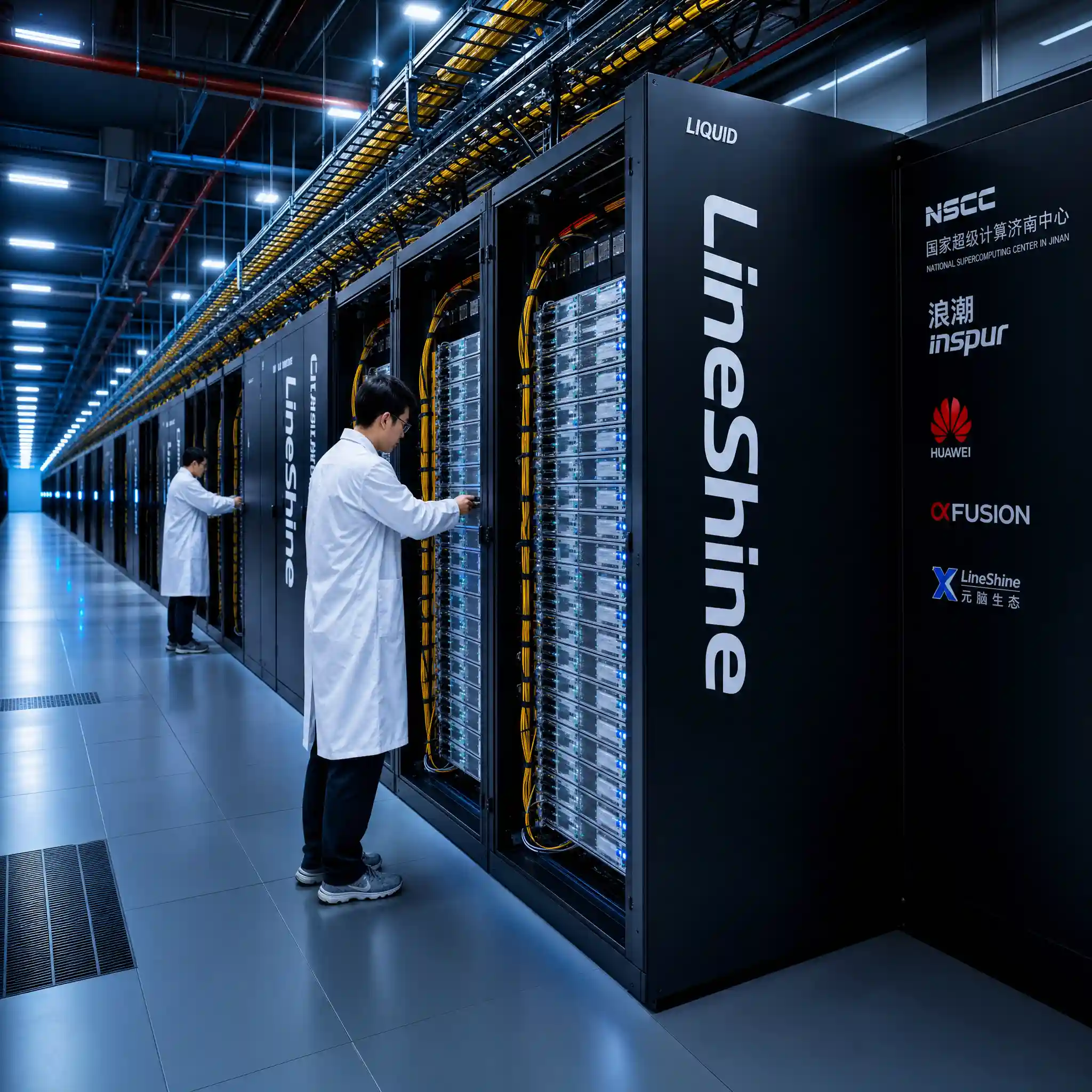
China has claimed the title of the world’s fastest supercomputer for the first time in nearly a decade. A system called LineShine now sits at the top of the closely watched TOP500 ranking. It pushed aside the United States machine that had held the lead since 2024. The result points to Beijing’s rising strength in advanced computing.
The new standings were announced at a major computing conference in Hamburg, Germany. For many researchers, the news landed as a clear signal. China can compete at the very highest level of computing even while facing tight limits on the chips it can buy from abroad.
LineShine is installed at the National Supercomputing Centre in Shenzhen. It recorded a performance of 2.198 exaflops on the test used to rank these machines. That figure means it can carry out more than 2 quintillion calculations every second. Its score sits more than 20 percent above the next system on the list.
The achievement carries extra weight for China. It is the first time a Chinese system has topped the ranking since Sunway TaihuLight did so in 2017. After that high point, Chinese teams largely stepped back from the project for several years.
A Supercomputer Built Entirely on Chinese Parts
Most leading supercomputers lean heavily on graphics processing units, known as GPUs. These chips power the AI systems that millions of people now use every day, including chatbots like ChatGPT. LineShine took a very different path. It runs entirely on general-purpose central processing units, known as CPUs.
CPUs carry fewer cores than GPUs. They also tend to be slower on the most complex tasks. That context makes LineShine’s result stand out. It is the first machine in the world to pass 2 exaflops of sustained performance using a CPU-only design.
The system was built around custom Chinese processors and homegrown software. That design choice sits at the heart of the story. It suggests China can reach the frontier of computing with parts made at home rather than imported from abroad.
The US Still Has Three of the Five Fastest Machines
The United States still holds a strong presence near the summit. El Capitan, based at the Lawrence Livermore National Laboratory in California, now ranks second. It had led the list since November 2024 before LineShine arrived.
Two more American systems follow close behind. Frontier at the Oak Ridge National Laboratory in Tennessee sits third. Aurora at the Argonne National Laboratory in Illinois takes fourth place. A German system called Jupiter, run by the Julich Supercomputing Centre, rounds out the top five.
The wider list reflects a broad field of competitors. The United Kingdom, Japan, South Korea, Italy, the Netherlands and Switzerland all placed machines among the top 20. The race for raw computing power clearly stretches well beyond two rival superpowers.
How US Chip Restrictions Pushed China to Build Its Own
The result speaks directly to a long-running policy debate. The United States has restricted China’s access to the most advanced chips for years. Jack Dongarra, a computer scientist who helps organise the ranking, said those limits cut both ways.
He explained that export controls can slow China’s access to certain advanced parts. At the same time, they hand the country a strong reason to build domestic alternatives. Dongarra said he was not entirely surprised to see China take the lead.
In his view, LineShine reflects large-scale investment and careful work that pairs hardware with software. He also offered a longer-term warning for policymakers. Controls may hold China back in the short run. They may also speed up its drive toward technological self-sufficiency.
The Ranking Is Useful, but It Has Real Limits
The ranking has tracked the world’s most powerful machines since 1993. Two computer scientists, Erich Strohmaier and Hans Meuer, started it ahead of an industry conference. It scores each system using a benchmark that measures how quickly it can solve a large set of linear equations.
China once dominated this list. Its machines filled close to half of the available spots in 2019. Participation then faded as relations between Washington and Beijing grew more strained.
Some experts now question how much the list still tells us. The way computers are used has shifted a great deal since AI took off. Large technology firms such as Microsoft, Amazon, Meta and Alphabet drive much of today’s AI work. Yet the ranking mostly features government and university systems that volunteer to take part.
Independent estimates suggest these public leaders trail the largest private clusters by a wide margin. By some accounts, El Capitan delivers only a fraction of the raw power inside xAI’s Colossus facility in Memphis, Tennessee. Dongarra stressed that the ranking captures just one benchmark. He said it should not be read as a complete measure of technological leadership.
He pointed to several other factors that matter just as much. These include real-world scientific performance, energy efficiency, software quality, reliability and ease of use.
In AI, the Gap Between the Two Countries Has Nearly Closed
LineShine arrives in the middle of a fierce contest over advanced technology. China and the United States have traded sanctions and export controls for the better part of a decade. Each side has tried to blunt the other’s progress in fields like AI.
A recent report from Stanford University adds useful context. It found that China has effectively closed the gap in AI model performance with the United States. American labs still produce more top-tier models. China, for its part, leads in patents and in the rollout of industrial robots.
Industry analyst Addison Snell said the LineShine result should ripple across the United States, Europe and Japan. He noted that the United States still leads in technology overall. The gap, in his view, is no longer a wide one. He expects the global order to keep shifting at a rapid pace.
Computing Power Alone Does Not Decide the Race
China now holds the crown. It got there not by importing the best chips, but by building around their absence. That detail matters more than the benchmark score itself.
The United States still leads in AI model performance, private investment, and the number of top-tier systems it operates. But the margin on every one of those measures has been shrinking. A country that was largely absent from this ranking seven years ago just topped it with hardware no one outside China had seen before.
The real question is not whether LineShine is the fastest machine in the world. It is what gets built next, and whether the rest of the world will see it coming this time.
Discover how AI is reshaping technology, business, and healthcare—without the hype.
Visit InfluenceOfAI.com for easy-to-understand insights, expert analysis, and real-world applications of artificial intelligence. From the latest tools to emerging trends, we help you navigate the AI landscape with clarity and confidence