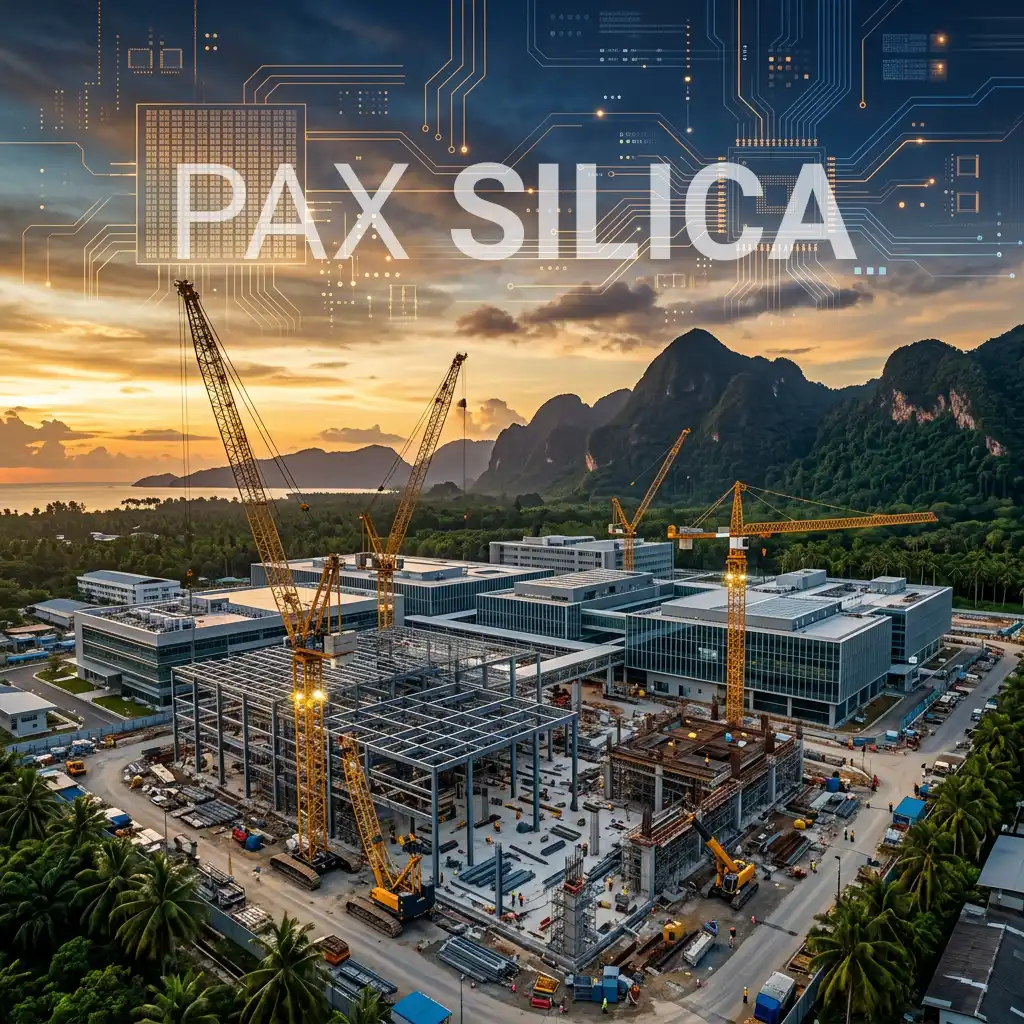
Answer: Pax Silica is a US-led coalition, launched in Washington in December 2025, that coordinates supply chains for chips, critical minerals, and AI infrastructure among partner countries. Its flagship project so far is a proposed 4,000-acre AI and semiconductor hub in New Clark City, Philippines, nicknamed the “Golden Node,” with Foxconn reportedly lined up as anchor tenant and a framework agreement targeted for signing in November 2026.
Quick Summary:
- Pax Silica launched in Washington, D.C. on December 12, 2025.
- The Philippines joined in April 2026 and offered 4,000 acres (about 1,618 hectares) in New Clark City, Tarlac, for a proposed industrial hub.
- Officials estimate the hub could draw $40–70 billion in investment and create 190,000 direct jobs, with up to 800,000 including indirect employment.
- Foxconn has been named as the likely anchor tenant, with funding expected to flow partly through the US International Development Finance Corporation.
- A framework agreement is being targeted for November 2026, timed to a possible presidential visit around the ASEAN Summit in Manila.
- Power, water, and Indigenous land use remain unresolved and contested.
- Critics, including farmers’ groups, environmental organizations, and left-leaning lawmakers, have called the project a “sellout” of land, minerals, and sovereignty; the government disputes that framing.
What is Pax Silica
Strip away the name and Pax Silica is a coalition, not a company or a product. It’s a US-led framework for coordinating the supply chains that AI actually runs on: silicon, semiconductors, critical minerals, and advanced manufacturing capacity. Member countries, including the Philippines and Italy, sign on to cooperate on securing and diversifying those supply chains rather than depending on any single country for them.
The name is a nod to what the whole thing is built on. Silica is silicon dioxide; silicon is the base material of every chip on Earth. Pair that with “Pax,” Latin for peace and borrowed the same way “Pax Americana” describes a US-anchored order, and you get a name meant to signal a US-anchored order for the silicon age.
It was launched at a summit in Washington on December 12, 2025, convened by US Undersecretary of State for Economic Affairs Jacob Helberg. Since then it’s grown into a multi-country coalition, though exact membership figures vary by source and month: some put it at roughly 20 countries as of mid-2026, others higher. Worth checking the State Department’s latest count before quoting a specific number.
AI Doesn’t Run on Code Alone, It Runs on Factories
It’s easy to think of AI as pure software: a chatbot, a model, an app. But none of that runs without an enormous physical backbone: advanced processors, power-hungry data centers, and the mineral and manufacturing supply chains that build them in the first place.
That backbone has its own bottlenecks. Advanced chips need specialized fabrication equipment and materials that only a handful of countries can produce. Data centers need electricity at a scale most national grids weren’t built for. Critical minerals, the stuff inside batteries, magnets, and semiconductors, are concentrated in a small number of countries, some of them geopolitically inconvenient for Washington.
That’s the real reason AI policy has quietly become industrial policy. Whoever wants a serious position in AI has to also answer: where do the chips get made, where do the minerals come from, and is there enough power and land to build any of it at scale? Pax Silica is the US answer to that question.
Why Washington Is Driving This, Not Silicon Valley
The US is treating resilient tech supply chains as a national and economic security issue, not just an industry one. That’s why the coalition is being run out of the State Department rather than left to individual chipmakers to sort out among themselves.
Pax Silica isn’t limited to one sector. It links raw materials, semiconductor fabrication, manufacturing capacity, and AI infrastructure under one umbrella, with participating countries expected to bring different pieces of that puzzle.Italy and the US formalized Italy’s participation, aimed at strengthening AI-related supply chains and reducing dependence on countries outside the network.
That’s a meaningfully different animal than a typical trade or tech partnership. It’s less about any one deal and more about who gets to be inside the tent when the industrial map of AI gets redrawn.
How the Philippines Got a Seat at the Table
The Philippines joined Pax Silica in April 2026. In the same announcement, the US and Philippine governments unveiled plans for a roughly 4,000-acre industrial zone inside the Luzon Economic Corridor.
New Clark City wasn’t picked at random. The Philippines already has decades of experience in electronics assembly and semiconductor-adjacent manufacturing, a large pool of technically trained workers, and access to minerals relevant to chip production. Finance Secretary Frederick Go has framed the move as an attempt to stop supplying the global economy “from the margins” and instead build the industries directly.
The pitch from Manila is straightforward: instead of staying in lower-value assembly work, the country wants a real foothold in the higher-value parts of the chain, namely AI infrastructure, semiconductor fabrication, and the mineral processing that feeds them.
Inside the Plan for New Clark City
The centerpiece is a proposed AI-native industrial hub on about 4,000 acres (roughly 1,618–1,620 hectares) in New Clark City, Tarlac, inside the Luzon Economic Corridor. It’s been officially designated a “Golden Node,” a term US Undersecretary Jacob Helberg used to describe a new category of AI-native investment acceleration hub. As he put it, the goal isn’t recreating last century’s factories; it’s building manufacturing ecosystems that are AI-native from day one and anchored inside a network of trusted partner nations.
The BCDA has allocated the land and offered a two-year lease-free period to support planning. Development is expected to proceed in phases, with groundbreaking on the first phase targeted within that window. As of July 2026, the US and Philippine governments were finalizing the draft framework agreement, with signing targeted for November, timed to a possible Trump visit for the ASEAN Summit in Manila, according to officials.
What Would Actually Get Built There
Officials have floated several components for the site: semiconductor fabrication facilities, critical-mineral processing, hyperscale data centers, AI infrastructure, and research facilities. None of that is finalized construction. It’s a planning-stage wishlist that will depend on which investors actually commit.
One name has moved past “wishlist,” though: Foxconn has been reported as the anchor tenant, with infrastructure funding expected to lean heavily on the US International Development Finance Corporation. That’s a significant signal, since Foxconn committing gives the project a concrete manufacturing partner rather than just a plan on paper. Still, the overall framework agreement isn’t signed yet, so treat the full buildout as a proposal, not a done deal.
Who’s Already Circling (Including Foxconn)
Interest has been building in stages. Philippine officials said more than 20 firms had expressed interest in the Luzon Economic Corridor by May 2026. By July, that number had reportedly grown to over 50 companies, according to the Bases Conversion and Development Authority.
The government is now also working on tax and investment incentives to make the Philippines more competitive against other Pax Silica sites. The appeal is straightforward: a hub like this can pull manufacturers, infrastructure providers, research institutions, and suppliers into one place, which is exactly the kind of ecosystem effect that’s hard to replicate piecemeal.
BCDA estimates put potential investment at $40–70 billion once fully built out, with direct employment of 130,000–190,000 jobs and up to 800,000 when you count indirect jobs in logistics, services, and supporting industries. Those are BCDA’s own projections, not independently audited figures. Useful for understanding ambition, not a guarantee of outcome.
The Catch: Power and Water
This is the part that gets glossed over in most coverage, and it shouldn’t be.
AI facilities are enormous power draws. The Philippine Department of Energy said in July 2026 that it was reviewing the hub’s electricity requirements and weighing additional generation capacity in Central Luzon, specifically so the project doesn’t end up competing with existing users for scarce power.
Water is the other open question. The National Water Resources Board has assessed available water sources in the area, and officials say community needs will stay a priority, with usage monitored by relevant agencies. There’s also a land-use dimension that’s easy to miss: BCDA says roughly 15,000 hectares in the nearby Clark Freeport are already allocated to Indigenous groups, and the company has pledged to keep about 40% of the New Clark City site as open space. Whether that holds up once construction starts is exactly the kind of thing worth watching, not assuming.
None of this is a footnote. A hub this size lives or dies on whether the power, water, and transportation infrastructure around it can actually keep up. Attracting tenants is the easy part.
Not Everyone Is On Board
This is the part official statements tend to skip past, and it’s grown loud enough that it can’t really be left out anymore.
The sovereignty flashpoint. In May 2026, the Philippine government reportedly rejected a US request for diplomatic immunity at the planned hub, according to a report. A US official later said the immunity request had been “taken out of context.” Whatever the full story, the episode became a rallying point for critics who argue Pax Silica risks handing over more control than the government is publicly admitting.
“Sellout” framing from farmers’ and left-leaning groups. Several organizations have described the project as a sellout of the country’s land, minerals, and sovereignty. In mid-2026, awmakers warned that the hub’s projected 5-gigawatt electricity demand could strain an already fragile national grid and push electricity prices higher nationwide. They’ve also raised concerns that planned energy infrastructure, including an LNG pipeline between Subic and Clark, could lock the Philippines into dependence on foreign-controlled energy systems.
Displacement and environmental concerns. An environmental group has raised the possibility that development could displace roughly 20,000 Aeta Indigenous people and farmers in the area, alongside worries about noise pollution and its effect on local wildlife. A broader coalition of scientists, environmental advocates, church organizations, and Indigenous rights groups has pushed back on the project, some framing it as resource “plunder,” and has called for more public consultation and stronger environmental safeguards before construction proceeds.
The government’s response. BCDA has disputed the characterization of the hub as primarily a water-intensive data center campus, insisting the project is centered on advanced manufacturing rather than server farms alone. Officials have also pointed to the two-year planning window and ongoing agency reviews of power and water capacity as evidence that safeguards are being built in, not skipped.
A regional footnote worth knowing. India’s absence from Pax Silica’s original member list drew its own criticism, with commentators and opposition politicians questioning why a country with a growing semiconductor sector was left out of a coalition explicitly built around “trusted” technology partners.
None of this means the project is doomed, and none of it means the criticism is unfounded either. Filipino commentators have argued the debate itself needs to stay evidence-based rather than collapsing into “pro-development” versus “anti-development” sloganeering on either side. That’s probably the most useful framing for readers too: the economic case and the criticisms are both real, and which one wins out will depend on governance decisions that haven’t been made yet.
What’s Actually at Stake for the Philippines
If it works, the upside is real: higher-value jobs, deeper integration into global chip and AI supply chains, and a stronger negotiating position with manufacturers looking to diversify out of China and Taiwan-adjacent risk. That’s the strategic logic Philippine officials are leaning on, and it’s not unreasonable.
But “if it works” is doing a lot of the lifting in that sentence. Framework agreements, environmental reviews, Indigenous land commitments, and power-grid upgrades all have to land in roughly the right order for the economic promise to materialize. Any one of them slipping pushes the timeline, and the jobs numbers, further out.
What to Watch For Next
The next twelve months are less about announcements and more about whether paper commitments turn into contracts and concrete. Watch for:
- The framework agreement, targeted for signing around the November 2026 ASEAN Summit in Manila.
- Foxconn’s formal commitment and any additional anchor tenants beyond it.
- The Department of Energy’s findings on whether Central Luzon can support the hub’s power draw without squeezing other users.
- How BCDA handles the Indigenous land and open-space commitments once phase one construction actually starts.
- Whether membership and investment figures hold up. Pax Silica’s country count and dollar estimates have shifted across different official statements, so treat any single number as a snapshot, not a fixed total.
Bottom Line
Pax Silica isn’t really a story about AI models. It’s a story about who controls the chips, minerals, and factories underneath them. New Clark City is the clearest real-world test of that strategy so far: a proposed AI-native industrial ecosystem, not just a data center, built around Foxconn as an anchor tenant and billions in potential investment.
Whether it delivers depends on things that don’t make for exciting headlines: signed contracts, power grid upgrades, water allocation, and land commitments actually holding up once construction starts. Follow those, not just the announcements, and you’ll know before anyone else whether Pax Silica becomes a template for other countries or a cautionary tale about promises outrunning infrastructure.
Discover how AI is reshaping technology, business, and healthcare—without the hype.
Visit InfluenceOfAI.com for easy-to-understand insights, expert analysis, and real-world applications of artificial intelligence. From the latest tools to emerging trends, we help you navigate the AI landscape with clarity and confidence