Quick Summary
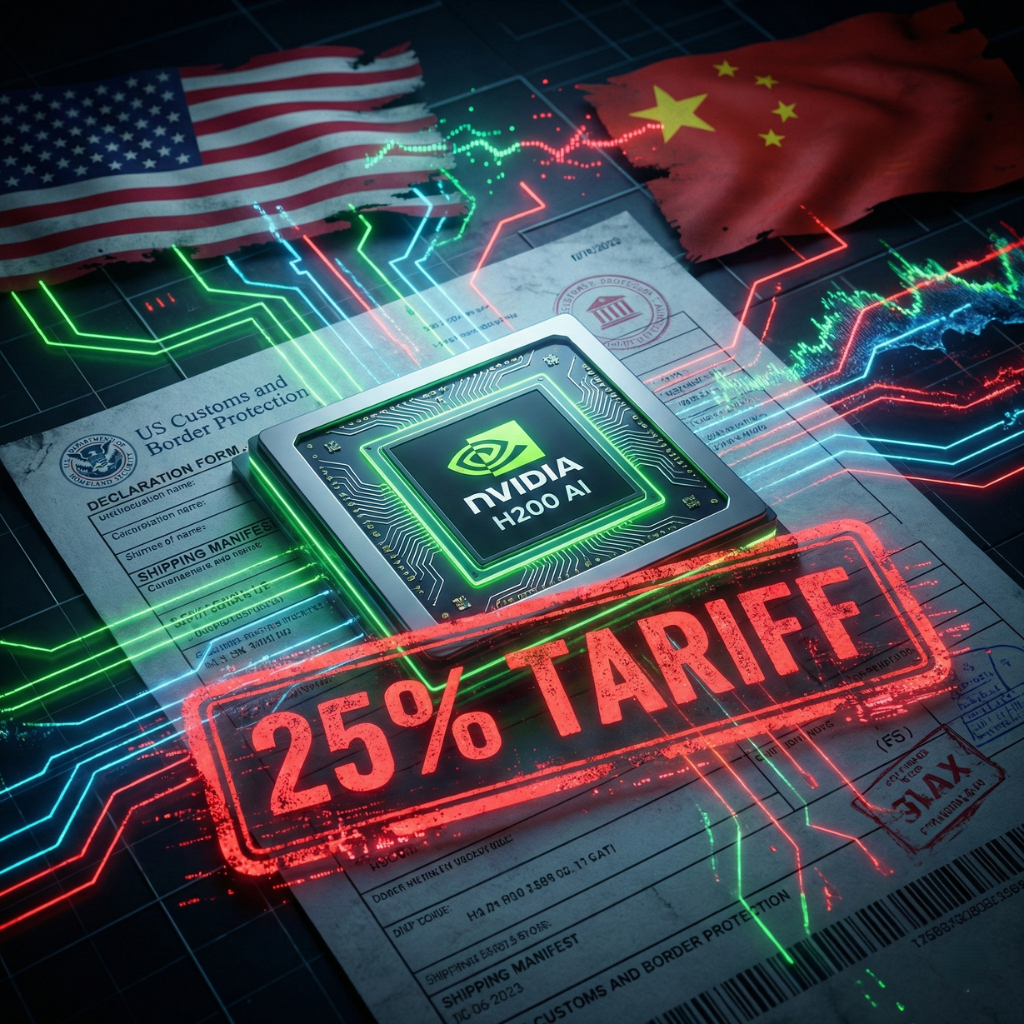
- The U.S. has imposed a 25% tariff on Nvidia H200 AI chips.
- The tariff affects chips imported into the U.S. and then exported to China.
- It’s framed as a national security move to reduce dependence on foreign chip production.
- Nvidia may absorb or pass on the extra cost depending on the market.
- China may accelerate domestic chip efforts in response.
- The policy could reshape global AI hardware trade and supply chains.
What’s Behind the Nvidia H200 Tariff?
Trump has announced 25% import duty on advanced Nvidia’s H200 AI chips. These chips are among the most powerful processors used for AI training, large-scale simulations, and data center operations. They are critical to industries ranging from cloud computing to defense.
The tariff applies when companies import these chips into the United States and then ship them to China or other foreign destinations. It reflects a broader strategy to reduce U.S. dependence on foreign manufacturing, especially from Taiwan, and to keep strategic tech assets from boosting rival economies.
Why the U.S. Is Targeting AI Chips Now
This policy didn’t come out of nowhere. The U.S. government launched a Section 232 investigation under the Trade Expansion Act of 1962. That legal tool allows tariffs if specific imports are seen as threats to national security.
The White House argues that heavy reliance on offshore chipmakers, especially for high-performance chips, could create vulnerabilities. The administration sees the Nvidia H200 tariff as a way to protect domestic innovation, encourage local manufacturing, and control how powerful AI chips flow into competing markets like China.
How the Nvidia Chip Tariff Actually Works
The tariff targets a specific use case. If an advanced chip is manufactured abroad, imported into the U.S., and then exported to a foreign country, it triggers a 25% tariff. This means Nvidia or its partners must pay the duty before the chip leaves U.S. borders.
But there’s a caveat. Chips that remain in the U.S. or support U.S. industry may be exempt. That includes products used in domestic cloud computing, AI startups, and enterprise systems. The structure allows flexibility while still discouraging exports of top-tier AI hardware to strategic rivals.
Will Nvidia Take the Hit or Pass It On?
Nvidia finds itself at the center of this shift. The H200 is one of its most valuable products in the global market. It’s designed in the U.S., but manufactured by foundries like TSMC overseas. That makes it a prime example of a globalized product now subject to national policy friction.
Nvidia may choose to absorb some of the cost. It could also pass it on to buyers in the form of higher prices. For now, Nvidia appears to support the move; citing the ability to still serve international markets under a rules-based system. The company has also emphasized that U.S.-based jobs and research benefit from the export business.
Can China Still Compete in AI After This?
China has been racing to secure access to advanced AI chips, and the Nvidia H200 tariff could slow that progress. The additional cost of acquiring H200 chips might limit how many are purchased or accelerate China’s push to build its own alternatives.
The Chinese government is already drafting purchase guidelines for local firms. These rules may limit dependence on U.S. chips and push more investment into domestic silicon. If successful, that shift could deepen tech decoupling between the two countries.
Either way, China’s AI development will likely be affected. Reduced access to top-tier hardware may impact everything from research to product deployment timelines.
Is This the Start of a Global AI Trade War?
The Nvidia H200 tariff may be the first major step in a broader pattern of economic tension around AI. By taxing chips critical to machine learning and neural network training, the U.S. is signaling that AI hardware is now a national interest issue.
Other countries may follow suit. Some might impose their own tariffs. Others could offer incentives for local chip production. This could fragment the global supply chain for semiconductors; similar to what we’ve seen with energy or pharmaceuticals.
The international tech market is watching closely. A single tariff can reset pricing models, shift logistics, and trigger long-term investment changes across the globe.
What Happens Next for the AI Chip Market?
The proclamation gives the U.S. Commerce Department power to adjust or expand the tariff rules. This flexibility means the policy could evolve as market dynamics change.
Companies like Nvidia, AMD, and Intel may respond by adjusting supply chains. They could increase chip packaging and final assembly in the U.S. to avoid re-export duties. That shift might create new domestic jobs but also increase production costs.
Meanwhile, governments in Asia and Europe may look to reduce reliance on U.S.-designed chips. If so, new chip startups could emerge, further decentralizing control over AI hardware.
Final Thoughts: AI, Power, and the Cost of Control
The Nvidia H200 tariff highlights the growing power of AI chips, not just in technology, but also in politics. This is not just a tax on hardware. It’s a strategic lever that could reshape how nations compete in artificial intelligence.
For Nvidia, this is a high-stakes moment. For China, it’s a push to innovate locally. And for the rest of the world, it’s a signal that AI supply chains will no longer be neutral ground.
As AI continues to influence everything from healthcare to defense, expect more policies like this. The future of innovation will depend not just on ideas, but on where those ideas are built, shipped, and taxed.
Discover how AI is reshaping technology, business, and healthcare—without the hype.
Visit InfluenceOfAI.com for easy-to-understand insights, expert analysis, and real-world applications of artificial intelligence. From the latest tools to emerging trends, we help you navigate the AI landscape with clarity and confidence.