Quick Summary
- AEO vs GEO are two distinct strategies shaping how brands get discovered through AI-powered search in 2026.
- AI-generated search summaries are reducing the number of people who click on traditional web results, with some users ending their session without visiting any link at all.
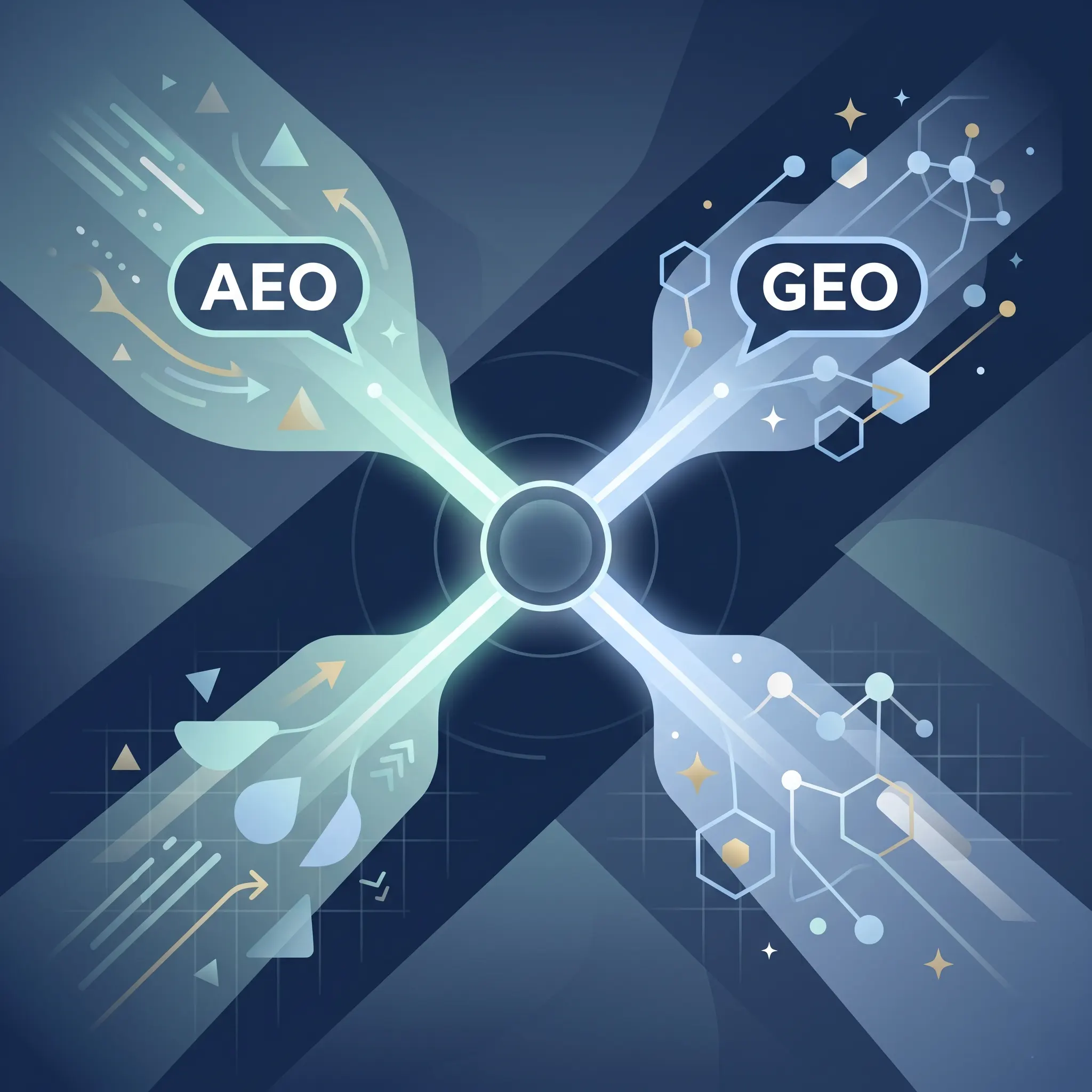
- AEO (Answer Engine Optimisation) focuses on structuring content so AI tools can extract clean, direct answers to specific questions.
- GEO (Generative Engine Optimisation) is about building broad credibility so that AI platforms like ChatGPT and Perplexity cite your brand as a trusted source.
- A brand can rank well on Google through AEO and still be completely absent from AI-generated responses if its GEO presence is weak.
- Research from BrightEdge found that 89% of AI Overview citations come from pages ranked outside the top 100 in traditional search results.
- Brands cited inside AI-generated summaries earn significantly more organic and paid clicks than those left out entirely.
- Marketing leaders are rapidly shifting budgets toward GEO, with many now treating AI search visibility as a core strategic priority rather than an experimental channel.
Introduction
AEO vs GEO has become one of the more important conversations in digital marketing, and for good reason. A study analyzing nearly 69,000 Google searches found that users who saw an AI-generated summary clicked on a traditional search result only 8% of the time. Users who did not see a summary clicked at nearly double that rate. A full quarter of people who encountered an AI summary left the search session without clicking on anything at all.
That behavioral shift is not a minor fluctuation. It reflects a fundamental change in where and how people get information. As generative AI platforms attract billions of monthly visits, the question for any brand is no longer whether AI search matters. It is whether your content is built for the two very different ways AI systems retrieve and present information.
Why Clicks Are Declining Even as Searches Rise
The volume of searches is not shrinking. What is shrinking is the share of those searches that lead anywhere.
It is reported in mid-2025 that Google search impressions increased 49% in the year following the launch of AI Overviews. Over that same window, click-through rates fell by close to 30%. Another research, covering over 25 million organic impressions across 42 organizations, put the decline even sharper for queries that triggered AI Overviews. Organic click-through rates dropped from 1.76% to 0.61%. Paid click-through rates fell from 19.7% to 6.34%. Even queries that did not produce an AI summary saw organic click-through rates decline more than 40% year over year.
It is also found that by early 2025, roughly one in five Google searches produced an AI-generated summary at the top of the results page. Several reports had projected that traditional search volume could fall by as much as 25% by 2026. Whether or not that precise figure holds, the pattern is consistent across multiple sources. The answer has become the destination, and the brands that appear inside that answer are the ones most likely to be noticed.
What AEO vs GEO Actually Means
These two strategies are often mentioned together, but they target different parts of the AI search ecosystem.
Answer Engine Optimisation (AEO) is the practice of formatting content so AI systems can pull a clear, direct answer from it. This includes featured snippets, voice assistant responses, and the “People Also Ask” sections that appear within Google results. Practically, it involves writing question-based headings, opening with concise answers in the 40 to 80 word range, and using structured markup like FAQ and HowTo schema. The goal is to give AI a clean, extractable response to a specific query.
Generative Engine Optimisation (GEO) operates differently. It focuses on making a brand a trusted reference point for AI platforms that synthesize responses from multiple sources, such as ChatGPT, Perplexity, and Google’s Gemini. These platforms use a process called retrieval-augmented generation (RAG), drawing from a wide range of external content. GEO involves building semantic content clusters, using entity-rich language, developing multimodal assets, and earning co-mentions across publishers, directories, and third-party sites. The result, when done well, is that AI systems treat your brand as a reliable source worth citing.
Both approaches exist on top of traditional SEO foundations. Neither replaces the other.
The Gap Most Brands Are Missing
Performing well in one area does not guarantee presence in the other. This is the point that catches many marketing teams off guard.
A survey of nearly 2,000 consumers, conducted in August 2025, found that a brand’s own website accounts for just 5 to 10% of the sources AI search platforms reference when generating a response. The remaining 90% comes from publishers, review platforms, user-generated content, and affiliate sites. A brand that has invested heavily in its own AEO on Google may still be absent from a ChatGPT response if its third-party footprint is thin.
Also, it is found that 89% of AI Overview citations come from pages ranked beyond position 100 in standard search results. That is a significant finding. It means that traditional ranking position is becoming less predictive of AI visibility than content structure, semantic relevance, and off-site authority signals. A page that would never surface in the top ten blue links may still be the source an AI platform chooses to cite.
The Citation Gap Is Already Costing Brands
The competitive advantage of AI citation is measurable, not theoretical.
A research found that brands appearing in AI Overviews earned 35% more organic clicks and 91% more paid clicks compared to brands not included in those summaries. That is a substantial gap, and it grows wider as more searches produce AI-generated results. A survey also found that 44% of consumers already prefer AI-powered search as their primary method for finding information. For brands absent from those AI responses, that preference represents a significant blind spot in the discovery process.
Investment is following the data. Conductor research found that 32% of digital marketing leaders now rank GEO as their top budget priority for the year. Around 97% of those leaders reported positive results from their GEO efforts. An average of 12% of 2025 digital marketing budgets went toward GEO initiatives. Perhaps the most telling data point is that 93% of these leaders are building GEO capabilities internally, treating AI search visibility as too strategically important to hand off to external vendors.
How to Build Visibility in Both Channels
Understanding the distinction between AEO and GEO is useful, but it only matters if it leads to action.
A practical starting point is to run an audit of your current AI visibility. Open the major AI platforms and ask questions your customers are likely to ask. Note where your brand appears, where it does not, and which sources are being cited in your place. That gap becomes your roadmap. From there, AEO work focuses on structured answers, schema markup, and question-led content formats. GEO work focuses on semantic depth within your content, earning mentions across credible third-party sources, and ensuring your brand is well-represented in the kinds of publications and directories AI platforms tend to draw from.
These two tracks reinforce each other over time. Brands that build both a structured content layer and a broad credibility footprint are better positioned to appear across the full range of AI-driven discovery touchpoints. As AI systems move beyond summarizing information and begin acting more autonomously on behalf of users, such as booking, recommending, and purchasing, the brands those systems cite most often will be the brands they reach for first.
Conclusion
The shift toward AI-generated search results is not coming. It is already here, and its effects on how brands get found are measurable now. AEO vs GEO is not a debate about which strategy wins. It is a recognition that both dimensions of AI visibility require deliberate, separate attention.
Clicks are becoming optional. Summaries are becoming the product. The brands that understand this early and build both their structured answer presence and their broader AI authority are the ones most likely to remain visible as the search landscape continues to shift. Waiting to act until the pattern becomes more obvious means building from a much harder starting position, one where the default answers have already been set by someone else.
Discover how AI is reshaping technology, business, and healthcare—without the hype.
Visit InfluenceOfAI.com for easy-to-understand insights, expert analysis, and real-world applications of artificial intelligence. From the latest tools to emerging trends, we help you navigate the AI landscape with clarity and confidence