Quick Summary
- Google announced a full overhaul of its search product at I/O 2026, replacing blue links with AI agents
- The change sparked immediate backlash over accuracy, usability, and the removal of user choice
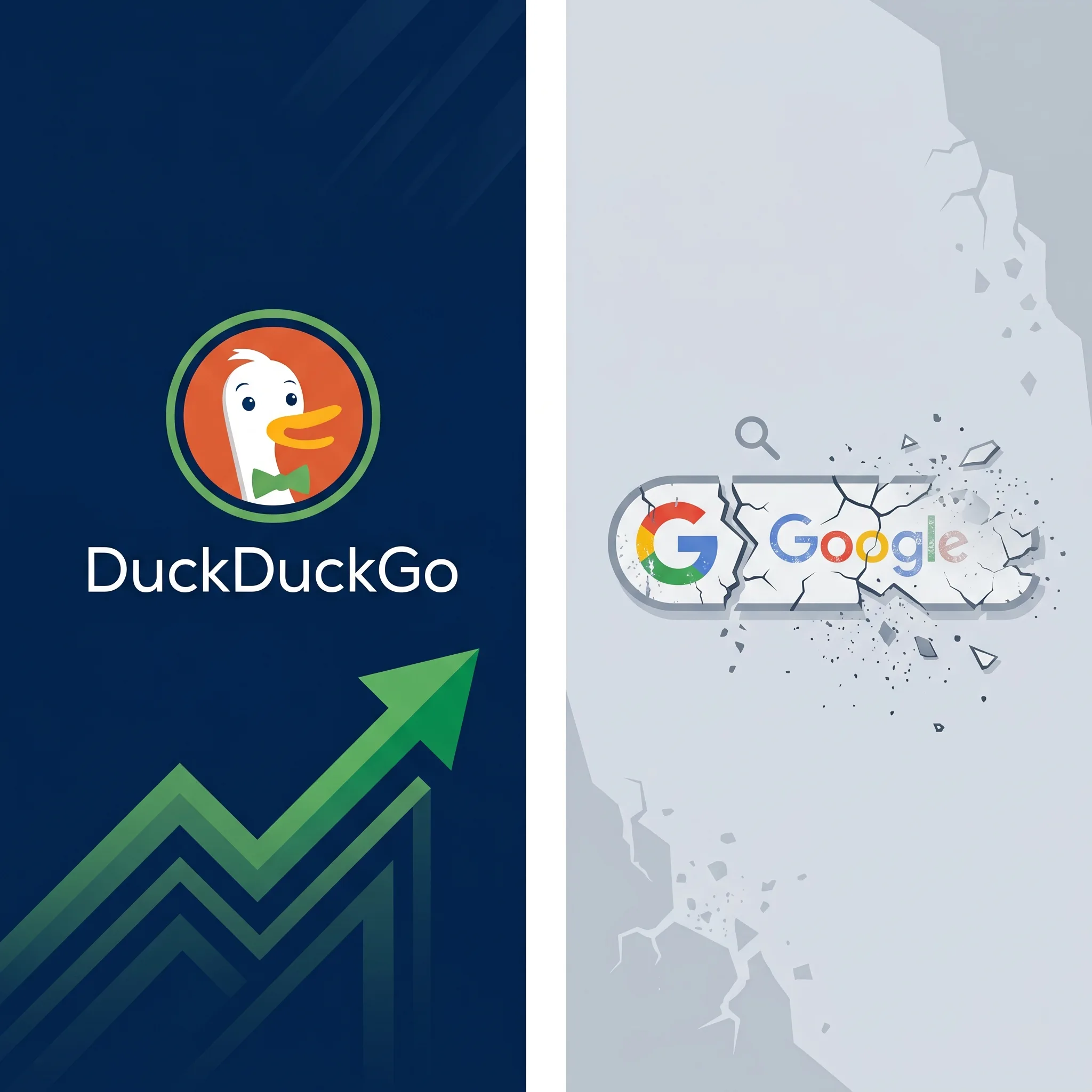
- DuckDuckGo search installs in the U.S. rose an average of 18.1% week-over-week, peaking at 30.5% in a single day
- iOS installs averaged 33% week-over-week growth and spiked as high as 69.9% on a single day
- Visits to DuckDuckGo’s AI-free search page grew an average of 22.7% week-over-week during the same period
- DuckDuckGo’s CEO accused Google of forcing AI on users with no option to turn it off
- The privacy-focused search engine holds about 2% of the U.S. market but is gaining noticeable momentum
Google Just Replaced Search as You Know It
DuckDuckGo search is growing fast, and the reason starts with what Google announced at I/O 2026. At its annual developer conference, Google revealed that the familiar list of blue links users have relied on for decades would be replaced by an AI agent. This agent is built to answer questions directly, complete tasks on a user’s behalf, and run background monitoring without additional input.
The shift is not subtle. Google is moving away from pointing users toward websites and toward resolving queries entirely within its own interface. For many users, that change felt less like an upgrade and more like a loss of control.
People Are Frustrated and They’re Speaking Up
The backlash was immediate. Critics raised concerns about what the overhaul means for independent publishers and the broader web, arguing that fewer outbound links from Google means less traffic reaching the sites people actually want to visit. Others pointed to a documented pattern of AI-generated summaries surfacing inaccurate or misleading information.
Everyday frustrations surfaced too. One widely shared example showed Google’s updated interface struggling to handle a simple search for the word “disregard.” Users found that tasks which once took seconds had become unnecessarily complicated. The common complaint across all of it was the same: Google made a major change and gave users no way to opt out.
Users Are Leaving and DuckDuckGo Search Is Benefiting
The frustration translated directly into action. DuckDuckGo search recorded U.S. app install growth averaging 18.1% week-over-week during the six-day window from May 20 to May 25, compared to the prior week. That growth held for six consecutive days and peaked at 30.5% on May 25. On iOS, the numbers were stronger still, with week-over-week install growth averaging 33% and hitting a single-day peak of 69.9%.
Traffic to DuckDuckGo’s AI-free search page climbed alongside installs. That page disables AI-assisted answers and AI-generated images by default. It averaged 22.7% week-over-week growth during the same period, peaking at 27.7% on May 24. Notably, the momentum carried through the Memorial Day weekend, a period when DuckDuckGo typically sees a seasonal drop in traffic.
DuckDuckGo CEO Gabriel Weinberg addressed the shift plainly. He said Google is pushing AI on users with no mechanism to turn it off and positioned DuckDuckGo as the alternative for people who want control over their own search experience. Weinberg raised similar concerns during Google’s search antitrust trial in 2023, where he testified that Google’s exclusive default search agreements had limited DuckDuckGo’s ability to compete on major browsers.
What You Actually Get With DuckDuckGo
DuckDuckGo search is a privacy-focused alternative that currently holds around 2% of the U.S. search market. It has never come close to threatening Google’s dominance, but it has built a consistent user base among people who prioritize privacy and straightforward results.
The company also offers its own AI product called Duck.ai. It is free, requires no account, and gives users access to several major language models. DuckDuckGo strips IP addresses before requests reach model providers, deletes conversations within 30 days, and does not allow chat data to be used for training. Users retain privacy whether they use the AI features or avoid them entirely.
DuckDuckGo also offers Search Assist, a feature similar to Google’s AI overviews, and an AI Image Filter that removes AI-generated images from results. According to the company’s chief communications and policy officer, both features rank among the most popular with users. The appeal, he said, comes down to one thing: people want to choose.
Conclusion
A 30% install spike off a 2% market share base does not threaten Google overnight. But it points to something real. A measurable group of users noticed what changed, decided it crossed a line, and went looking for an alternative. That kind of behavior is worth paying attention to.
Google has not publicly responded to the criticism. Whether it adjusts course or holds firm on its AI-first direction remains to be seen. For now, the data from DuckDuckGo search suggests that when users lose the ability to opt out, some of them will find their own way out.
The larger question around who controls the search experience is not going away. As AI becomes more embedded in everyday tools, user choice and transparency will keep coming up. DuckDuckGo’s recent numbers suggest that at least some users are done waiting for answers.
The search war is not over, but for the first time in years, Google has given people a reason to look elsewhere.
Discover how AI is reshaping technology, business, and healthcare—without the hype.
Visit InfluenceOfAI.com for easy-to-understand insights, expert analysis, and real-world applications of artificial intelligence. From the latest tools to emerging trends, we help you navigate the AI landscape with clarity and confidence