Quick Summary
- AI needs memory, not just data. Current enterprise software stores results but loses the reasoning behind them.
- Context Graphs bridge the gap. They capture decision traces, exceptions, and human judgment to power true autonomy.
- Incumbents are stuck. Legacy systems like CRMs and data warehouses are built for storage rather than active decision-making.
- Startups have the edge. New players can build the orchestration layer that captures the “why” alongside the “what.”
Context Graphs: The Missing Link to AI Autonomy
The next big shift in technology isn’t a faster chatbot. It isn’t a larger language model. It is a new layer of software that most people haven’t named yet. We call it the Context Graph. This is the bridge between cool demos and actual enterprise value.
Everyone is excited about AI agents right now. These programs promise to do work for you. They don’t just answer questions. They execute tasks. They book flights. They reconcile invoices. They close support tickets.
But there is a problem.
Agents are hitting a hard wall in the real world. They make mistakes. They get stuck. They lack judgment. The problem isn’t their intelligence. The problem is their memory.
Corporate memory is broken. We store data in giant silos. You have a system for customers. You have a system for employees. You have a system for operations. These systems are great at storing facts. They know a deal closed for $50,000.
But they don’t know why it closed for $50,000.
They don’t know the VP approved a discount for a strategic partner. They don’t know you ignored a standard policy due to a software bug. That context is gone. It lives in chat threads. It lives in video calls. It lives in people’s heads.
Agents need that context. Without it, they are flying blind. This is where Context Graphs come in.
The Real Problem with AI Agents
We have spent twenty years building systems to record the “now.” These databases hold the current state of the world. Your sales software knows the status of a lead. Your finance software knows the balance of an account.
But business doesn’t happen in the current state. Business happens in the flow.
Decisions are complex. They involve exceptions. They involve overrides. Imagine a support agent solving a complex ticket. They check the billing system. They check the bug tracker. They ask a manager for permission to issue a refund. They look at a similar case from last month.
Then they click “Refund” in the system. The system records one thing. “Refund Issued.”
It lost everything else. It lost the reasoning. It lost the manager’s approval. It lost the link to the bug report. This is a disaster for AI. If you train an AI on that data, it just sees the result. It doesn’t learn the nuance. It doesn’t learn the judgment.
Recent industry reports highlight this exact gap. Organizations are adopting AI but missing the underlying data foundations for true autonomy. You cannot automate what you do not record.
Data Without the “Why” is Just Noise
You might think you have enough data. You have lakes and warehouses full of it. But most of that data is dead. It tells you what happened. It rarely tells you why it happened.
This makes it impossible to audit decisions. You can’t explain why an agent took a specific action. You can’t improve the model effectively.
This concept aligns with what experts now call context engineering. Without connecting workflows and data systems, AI models remain blunt instruments. You need the full picture to get value.
A system that only sees the final score can’t teach you how to play the game. You need the play-by-play. You need the decision trace.
Enter the Context Graph
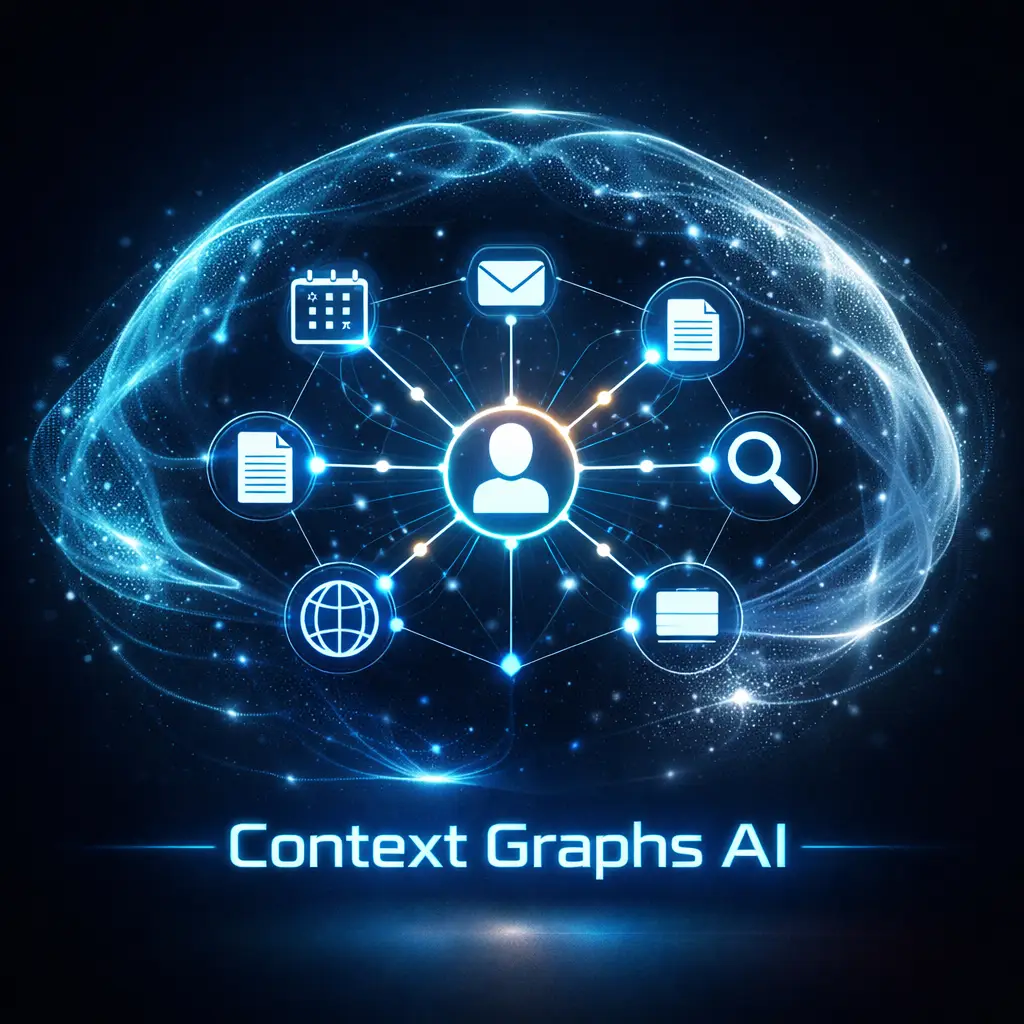
A Context Graph is a new way to store information. It doesn’t just store objects. It stores the journey. It records the path a decision took. It links entities together in time.
Think of it as a map of reasoning.
When an agent does work, it touches many systems. It pulls data from here. It checks a policy there. It asks a human for help. A Context Graph records that whole process.
It says: “We gave this discount because of Policy X, with an exception approved by Person Y, based on Precedent Z.”
This turns the “why” into data.
Now the agent has a memory. Next time it sees a similar situation, it can look up the precedent. It can see how humans handled it before. This makes the agent smarter over time. It transforms exceptions into rules.
This shift transforms how companies capture value from AI. It moves beyond simple efficiency. It creates a learning organization.
Why the Old Guard Can’t Build This
You might ask a simple question. Why can’t the big incumbent software companies just build this? Why can’t your data warehouse just store this?
They will try. But they have a structural problem. They are built for the wrong thing.
Legacy systems are built to store the “now.” They overwrite old data. When you change a deal status, the old status is gone. They are not designed to replay the state of the world at the moment a decision was made.
Data warehouses are built for reading. They take data from other systems and analyze it later. This is called “after the fact.” By the time data gets to the warehouse, the context is already stripped away. You see the result. You don’t see the decision.
Context Graphs need to sit in the action. They need to be in the “write path.”
This is the orchestration layer. This is where the agent lives. The agent is the one doing the work. It sees everything. It sees the inputs. It sees the policy. It sees the approval. The agent is uniquely positioned to capture the Context Graph.
Incumbents are too far away. They are storage lockers. They are not the factory floor.
The Three Paths for New Players
This opens a massive door for startups. We are going to see a new wave of enterprise software. These won’t just be “AI for X.” They will be “Systems of Decision.” They will capture the decision traces that the old systems missed.
There are three main ways this will happen.
1. Replacing the System of Record
Some startups will replace the old systems entirely. They will build a new sales platform from scratch. It will be AI-native. It will store every interaction and decision as a first-class object.
This is hard. Replacing a core database is risky. But for new companies, it is a no-brainer. Why buy a dumb database when you can buy a smart one?
2. The Module Replacement
Other startups will bite off a small piece. They won’t replace the whole financial system. They will just replace the “Cash Collection” module. Or the “Quote-to-Cash” workflow.
These are the messy parts. These are the parts with lots of emails and spreadsheets. The startup will build an agent to handle this workflow. The agent will build a Context Graph of every payment dispute and approval. The old system still keeps the ledger. But the intelligence moves to the new player.
3. The New Orchestration Layer
The biggest opportunity might be the layer on top. These companies won’t replace the database. They will sit between the database and the user.
They will be the interface. You will do your work in this new layer. The agent will help you. It will record your decisions. It will push the final result down to the old system.
Over time, this top layer becomes the real source of truth. The database underneath becomes just a dumb hard drive. This is where the value shifts. The value is no longer in holding the record. The value is in holding the context.
How to Spot the Opportunity
How do you spot these opportunities? Look for the mess. Look for high headcounts in “coordination” roles.
Do you have 50 people whose job is to “route tickets”? Do you have a team that just reads emails and updates fields? These are signals. They exist because the logic is too hard for old software. The logic lives in their heads.
This is prime territory for a Context Graph.
Look for workflows where the answer is “it depends.” If the rules are simple, you don’t need AI. You need a script. But if the rules are fuzzy, you need context. You need precedent. You need to know what we did last time.
Leading voices in tech argue that we are moving from systems of record to systems of work. This is where the nuance lives. This is where the money is.
The Era of Big Context
The era of “Big Data” is ending. We have enough data. We have too much data. We are entering the era of “Big Context.”
The companies that win the next decade won’t be the ones with the biggest databases. They will be the ones that can answer “why.” They will build the Context Graphs that turn messy human judgment into structured software assets.
This is not just an upgrade. It is a replacement of the operating system of business. It is a trillion-dollar shift. And it is just getting started.
Discover how AI is reshaping technology, business, and healthcare—without the hype.
Visit InfluenceOfAI.com for easy-to-understand insights, expert analysis, and real-world applications of artificial intelligence. From the latest tools to emerging trends, we help you navigate the AI landscape with clarity and confidence.