Quick Summary
- Vapi raised a $50 million Series B round
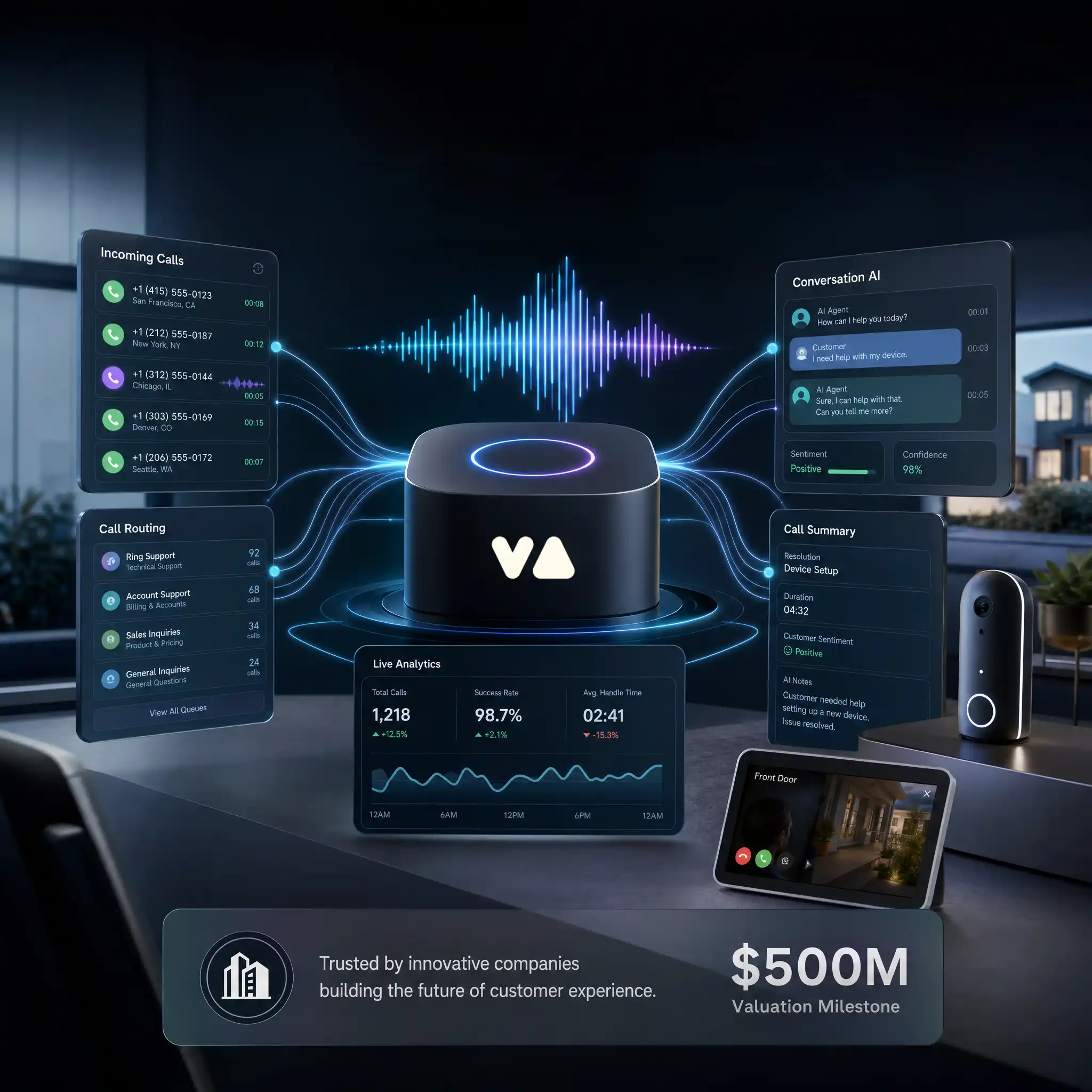
- The company reached a valuation of about $500 million
- Amazon Ring now routes all inbound calls through Vapi
- Ring evaluated more than 40 AI voice vendors before choosing Vapi
- Vapi says it has processed more than 1 billion calls
- The company now handles between 1 million and 5 million calls daily
- Enterprise demand for AI voice agents continues to accelerate
The Vapi AI voice platform has reached a $500 million valuation after landing a major enterprise customer. Amazon Ring selected Vapi over more than 40 competing vendors to manage inbound customer support calls. The deal reflects growing demand for enterprise voice AI systems that can operate at a large scale.
Why Amazon Ring picked Vapi
Amazon Ring faced a growing volume of customer support calls during the holiday shopping season last year. The company explored several options before making a decision. It considered expanding traditional call centers. It also reviewed older automated phone systems and newer AI voice agents.
According to the report, Ring tested more than 40 vendors before selecting Vapi. The company eventually moved all inbound customer support calls onto Vapi’s infrastructure.
Vapi CEO Jordan Dearsley said Ring wanted greater control over how AI agents behaved during customer conversations. He explained that Vapi allowed Ring engineers to fine-tune the experience in real time.
That flexibility appears to have played a major role in the final decision. Ring executive Jason Mitura said customer satisfaction scores improved after the rollout. He also noted that teams could adjust the AI experience without depending heavily on engineering resources.
The deployment highlights a broader shift happening across enterprise customer support. Companies increasingly want AI systems that sound more natural during conversations while still allowing businesses to control reliability and compliance.
Research has shown that businesses continue investing heavily in generative AI for customer operations and service automation. Industry analysts also expect conversational AI adoption to grow rapidly across support and sales environments over the next several years.
How Vapi started
Vapi’s origins look very different from its current enterprise focus.
Dearsley originally built an AI therapist in 2023 for conversations during daily walks. He and co-founder Nikhil Gupta discovered that businesses were less interested in the therapy application itself. Instead, startups became interested in the low-latency voice infrastructure running underneath it.
That insight pushed the founders to pivot toward developer tools and enterprise infrastructure.
The pair previously went through Y Combinator with another startup called Superpowered. They publicly launched Vapi in 2024 and focused on helping businesses build and manage AI voice agents.
Today, the company supports customer support systems, lead qualification tools, appointment scheduling, and outbound sales calls. The startup also offers a self-serve platform for developers building voice AI products.
That developer-first approach helped Vapi scale quickly before landing major enterprise contracts.
Dearsley said the company’s wide developer adoption helped stress-test the infrastructure early. He explained that the platform had already handled significant traffic before signing large enterprise customers.
The scale behind the platform
Vapi says it has now processed more than 1 billion calls through its system. The company currently handles between 1 million and 5 million calls every day. Enterprise customers represent most of that volume.
The company also says more than 1 million developers have used its self-serve platform.
That growth helped attract a major funding round. The Series B investment was reportedly led by Peak XV Partners. Other participating investors included M12, Kleiner Perkins, and Bessemer Venture Partners.
The company’s annual recurring revenue reportedly sits in the high eight figures.
Vapi currently has around 100 employees. The company plans to use the new funding to expand engineering, infrastructure, and go-to-market operations.
The rapid growth reflects a broader enterprise push toward AI automation. Businesses are increasingly testing systems that can reduce wait times, lower support costs, and handle repetitive customer interactions more efficiently.
Organizations like Gartner have projected that conversational AI will become a major part of customer service operations as companies seek scalable automation tools.
The growing voice AI race
Vapi operates in an increasingly crowded market.
The report names several competing companies in the voice AI space, including Sierra, Decagon, PolyAI, Bland, Retell, and ElevenLabs.
Many of these startups are competing to become the infrastructure layer behind AI-powered customer conversations.
Dearsley said Vapi focuses less on packaged applications and more on the orchestration layer underneath voice agents. That includes reliability, model control, compliance, and latency management.
This positioning may explain why large enterprises are willing to adopt specialized platforms instead of building systems internally.
The Ring deal is especially notable because Amazon already operates massive AI and cloud infrastructure businesses through Amazon Web Services. Despite that, Ring still selected an outside startup to handle customer-facing voice AI infrastructure.
That decision suggests enterprises may increasingly prioritize specialized AI performance over broader platform ownership.
Industry observers also see voice AI moving beyond small pilots into production-scale deployments. Large companies now appear more willing to place customer-facing interactions into AI systems when reliability improves.
Why investors are betting on Vapi AI voice
The new valuation places Vapi among the larger enterprise AI infrastructure startups.
The company’s momentum reflects a wider investor shift toward AI products that already show real enterprise adoption. Investors increasingly favor startups with production deployments and measurable usage instead of experimental prototypes.
Vapi’s Ring partnership gives the company a highly visible reference customer. That visibility could help accelerate future enterprise sales.
The startup also benefits from operating in one of the fastest-growing AI categories. Voice interfaces are becoming more important as companies look for more natural ways for customers to interact with automated systems.
Still, competition remains intense. Large technology companies and well-funded startups are racing to build increasingly capable conversational AI systems.
Success may depend on reliability more than novelty. Enterprise customers often prioritize consistency, compliance, and operational control over flashy demonstrations.
Dearsley described the challenge as managing unpredictable AI models while still delivering dependable business outcomes.
Conclusion
The rise of the Vapi AI voice platform shows how quickly enterprise voice AI is moving into mainstream customer operations.
Winning Amazon Ring over more than 40 competitors gave the startup both credibility and momentum. The company’s new funding round and $500 million valuation suggest investors believe demand for AI-powered voice systems will continue growing.
Vapi’s growth also highlights a broader shift across enterprise software. Businesses increasingly want AI systems that can operate at scale while still giving teams precise operational control.
As more companies automate customer conversations, the race to become the infrastructure layer behind enterprise voice AI is likely to intensify.
Discover how AI is reshaping technology, business, and healthcare—without the hype.
Visit InfluenceOfAI.com for easy-to-understand insights, expert analysis, and real-world applications of artificial intelligence. From the latest tools to emerging trends, we help you navigate the AI landscape with clarity and confidence