Quick Summary
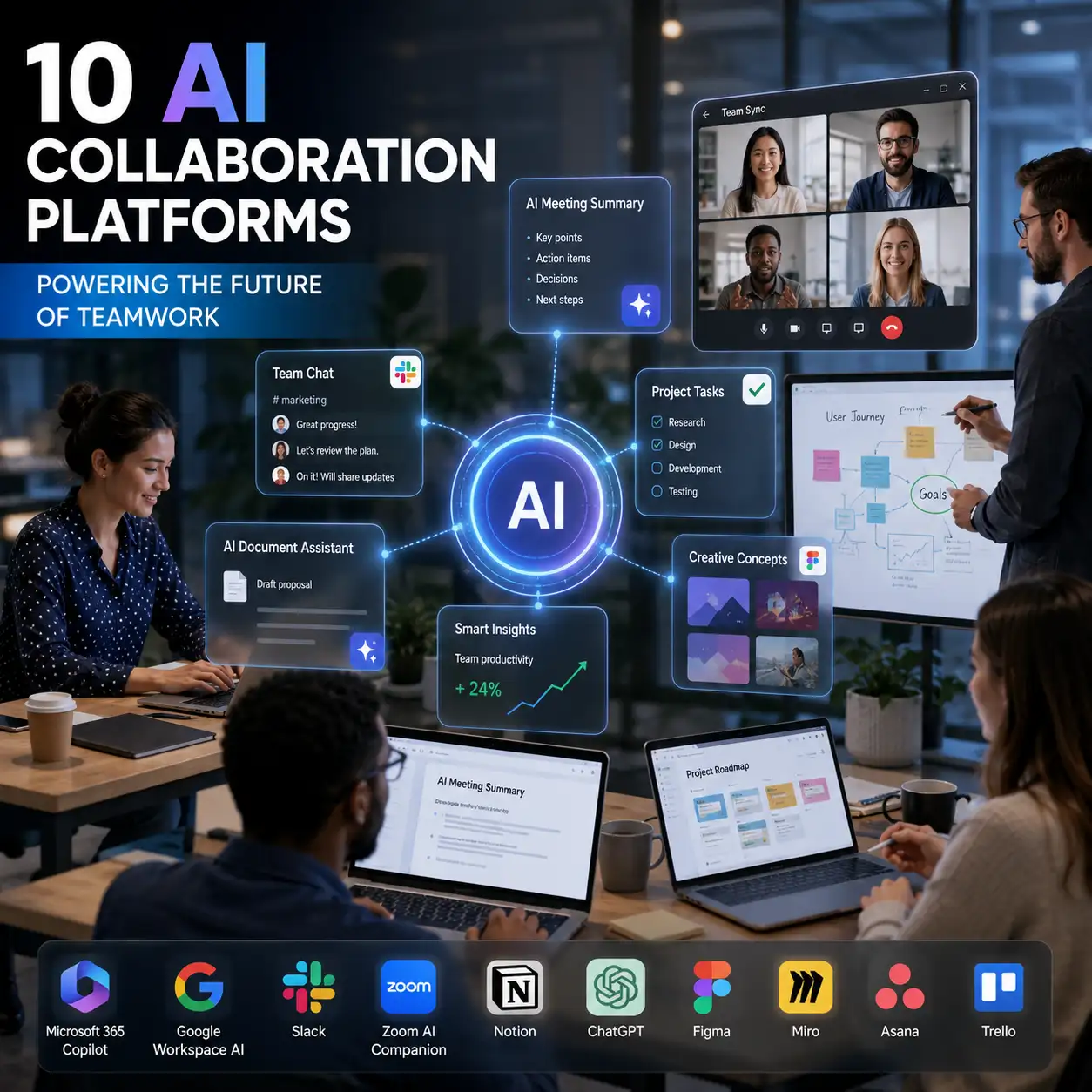
- AI collaboration platforms now combine communication, automation, and workflow management.
- Microsoft and Google lead because of deep integration across workplace software.
- Slack and Zoom remain strong because of communication-focused AI features.
- Design and visual collaboration platforms now use AI to speed up creative work.
- Project management platforms increasingly automate repetitive coordination tasks.
- Teams use these tools to reduce manual work and improve productivity.
- AI collaboration software is becoming central to hybrid and remote work.
Why Teams Are Switching to AI Collaboration Platforms
AI collaboration platforms are changing how teams work together. Many businesses now expect software to handle communication, organization, documentation, and automation in one place.
The strongest platforms combine productivity tools with generative AI features that reduce repetitive work. Teams can summarize meetings, draft content, organize projects, and manage workflows faster than before.
Some platforms lead because they already power enterprise workplaces. Others stand out because they improve creative collaboration or project management. The platforms below earned their ranking because of scale, AI capabilities, integration strength, and real-world workplace adoption.
1. Microsoft 365 Copilot
Microsoft 365 Copilot ranks first because it integrates AI across some of the most widely used workplace applications in the world.
The platform works inside Word, Excel, PowerPoint, Outlook, and Teams. Employees can generate reports, summarize meetings, analyze spreadsheets, and draft emails directly within their daily workflows.
Its biggest advantage comes from ecosystem depth. Many companies already rely on Microsoft software across departments. Copilot adds AI support without forcing teams to change how they work.
The platform also offers enterprise-level governance and security tools. This makes it especially attractive to large organizations managing sensitive business data.
2. Google Workspace AI
Google Workspace AI earns the second spot because of its cloud-first collaboration model and strong AI integration across Gmail, Docs, Meet, Sheets, and Slides.
Google focuses heavily on real-time teamwork. Multiple users can collaborate simultaneously while AI assists with writing, summaries, note generation, and presentation building.
The platform performs especially well for distributed teams that depend on browser-based workflows and lightweight collaboration tools.
Google’s strength comes from simplicity and accessibility. Its AI features feel naturally embedded into tools millions of employees already use daily.
3. Slack
Slack ranks third because it remains one of the most important communication hubs for modern workplaces.
The platform now uses AI to summarize conversations, surface important updates, and reduce information overload across channels.
Slack also integrates with a massive ecosystem of workplace tools. Teams can connect messaging directly to project management, customer support, engineering workflows, and internal operations.
Its position reflects how central communication has become in hybrid work environments. Slack succeeds because it keeps conversations connected to execution.
4. Zoom AI Companion
Zoom AI Companion ranks highly because meetings remain a major part of modern work.
The platform focuses on improving meeting productivity through AI-generated summaries, action items, and follow-up organization.
Teams no longer need to rely heavily on manual note-taking. Employees can stay focused on conversations while AI captures important details automatically.
Zoom’s strength comes from scale and specialization. Video meetings became essential during remote work growth. AI Companion helps reduce the administrative burden tied to those meetings.
5. Notion
Notion AI ranks fifth because it blends documentation, project management, and knowledge organization into one flexible workspace.
The platform helps teams centralize information while AI assists with summaries, drafting, brainstorming, and organization.
Notion became especially popular among startups, creative teams, and fast-moving organizations that value flexible workflows.
Its ranking reflects versatility. The platform adapts to many work styles while keeping AI features integrated directly into team knowledge systems.
6. ChatGPT
ChatGPT earns its position because it helped normalize AI-assisted work across industries.
Teams use ChatGPT for brainstorming, writing, summarization, coding support, and research tasks. Its conversational interface lowered the barrier for workplace AI adoption.
The platform works across many different workflows instead of focusing on one specific category.
Its ranking reflects influence and flexibility. ChatGPT became one of the most recognizable AI productivity tools in the workplace.
7. Figma
Figma ranks seventh because design collaboration is becoming increasingly AI-assisted.
The platform allows designers, developers, and product teams to collaborate visually in real time. AI features now help speed up ideation, layout generation, and workflow organization.
Figma stands out because collaboration happens directly inside the design environment instead of across disconnected tools.
Its position reflects growing demand for faster product development and collaborative creative workflows.
8. Miro
Miro earns its place because visual collaboration became essential for remote brainstorming and planning sessions.
The platform helps teams organize ideas through digital whiteboards, diagrams, and workflow mapping tools.
AI features now assist with summarization, clustering ideas, and organizing collaborative sessions more efficiently.
Miro performs especially well for workshops, strategy meetings, and product planning environments where visual thinking matters.
9. Asana
Asana ranks ninth because project coordination remains a major challenge for growing organizations.
The platform combines workflow management with AI-powered task prioritization and operational support.
Teams use Asana to organize timelines, track progress, and improve accountability across projects.
Its ranking reflects strong execution in structured project management rather than broader communication or creative collaboration.
10. Trello
Trello rounds out the list because of its simplicity and accessibility.
The platform uses visual boards and cards that make project organization easy for smaller teams and lightweight workflows.
AI integrations now help automate updates and summarize activity across projects.
Trello ranks lower mainly because it focuses on simpler project management use cases compared to more enterprise-focused competitors. Still, its ease of use keeps it highly popular across startups and small teams.
Conclusion
AI collaboration platforms are evolving into full workplace operating systems. Communication, documentation, meetings, project management, and automation now exist inside connected AI-powered environments.
Microsoft 365 Copilot leads because of enterprise integration depth. Google Workspace AI follows closely because of cloud collaboration strength. Slack and Zoom dominate communication-driven workflows. Platforms like Figma, Miro, Asana, and Trello specialize in creative and operational teamwork.
As businesses continue adopting hybrid work models, AI collaboration platforms will likely become even more central to daily productivity and decision-making.
Discover how AI is reshaping technology, business, and healthcare—without the hype.
Visit InfluenceOfAI.com for easy-to-understand insights, expert analysis, and real-world applications of artificial intelligence. From the latest tools to emerging trends, we help you navigate the AI landscape with clarity and confidence