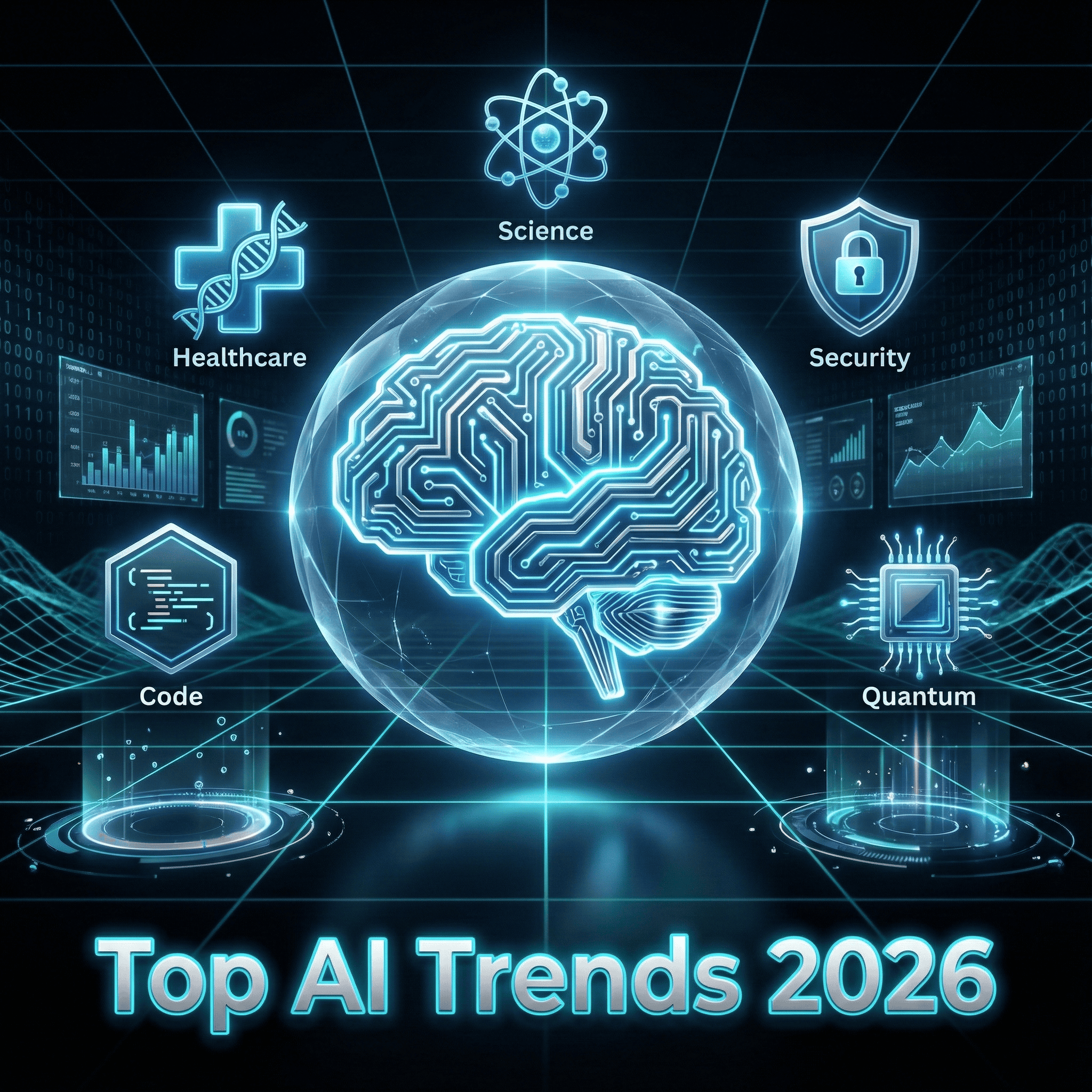
Quick Summary
- AI is shifting from tool to teammate across industries
- Digital agents will require security and identity safeguards
- AI will help close healthcare access gaps
- Scientific discovery will accelerate through AI-powered collaboration
- Smarter, leaner infrastructure will power AI more efficiently
- Developers will benefit from contextual AI code assistants
- Quantum computing will unlock new layers of AI performance
The top AI trends 2026 point to one clear shift. AI is no longer just a tool. It’s becoming a partner.
From healthcare to software, artificial intelligence is changing how we work, think, and solve real problems. What used to live in research labs is now part of daily life. AI systems write code, run experiments, answer medical questions, and manage infrastructure.
In 2026, these changes will move faster. Small teams will use AI to operate at enterprise scale. Scientists will test more ideas in less time. Patients will have more control over their health. Developers will build software with fewer errors and better context.
This guide explores the top AI trends 2026 that will shape the future. Each one shows how AI is evolving, and what it means for people, progress, and the way we live.
1. AI becomes a collaborative teammate
In 2026, artificial intelligence is evolving from assistant to ally. The future of work will include AI tools that collaborate directly with people, enhancing creativity, decision-making, and scale.
Small teams will launch global campaigns in days, with AI handling personalization, analysis, and production. Humans will focus on strategy and innovation. The goal is not to replace people. It’s to multiply what they can achieve.
Professionals who learn to work alongside AI will gain the most. It’s about co-creating, not competing.
According to a report by the World Economic Forum, 75% of companies expect to integrate AI in their operations by 2027.
2. AI agents will need strong identity protections
AI agents will become part of daily work life in 2026. They will handle scheduling, communication, data analysis, and even decision-making. But with that power comes a major responsibility — security.
Experts say every AI agent will need its own digital identity. Companies must control what data an agent can access, how it acts, and what systems it interacts with. Trust is essential.
Security will no longer be an afterthought. It will be embedded in every layer of AI. Defenders will also use AI to detect and stop attacks before they spread.
The National Institute of Standards and Technology (NIST) urges developers to integrate identity, auditability, and access control into all AI tools.
3. AI will help solve global healthcare challenges
The World Health Organization estimates that over 4.5 billion people lack access to basic healthcare services. AI is poised to close that gap.
In 2026, AI systems will assist with diagnostics, symptom triage, and treatment planning. Some are already outperforming experienced doctors in complex cases. These systems will move out of research labs and into clinics and homes.
AI chat tools are already answering tens of millions of health-related questions every day. In the near future, people will use AI to track symptoms, understand conditions, and manage wellness — even in underserved areas.
The WHO’s Global Strategy on Digital Health highlights AI as key to solving the shortage of health workers and improving access.
4. AI will join scientists in the discovery process
The next stage of AI will see it join researchers in the lab. It won’t just analyze results. It will suggest experiments, run simulations, and collaborate on discoveries.
Scientists will work side by side with AI lab assistants that understand the tools, context, and goals of complex studies. Whether modeling climate change, designing molecules, or exploring new materials, AI will become part of the team.
This is similar to “pair programming” in tech, where AI helps coders write, test, and improve code. Now, the scientific world is adopting the same approach.
A report from MIT states that AI in scientific research will reduce trial-and-error and bring new discoveries to market faster.
5. AI infrastructure will get smarter and leaner
As AI scales globally, raw computing power is no longer enough. 2026 will mark a shift from “more” to “better.” Companies will build infrastructure that adapts, optimizes, and conserves resources in real time.
These systems will operate like intelligent logistics hubs. If one workload slows, another will take its place. Every server, watt, and cycle will be used wisely.
This approach improves efficiency, reduces environmental impact, and lowers costs. The goal is to run large AI systems with less waste.
According to the International Energy Agency, smarter data centers can cut energy consumption by up to 40%.
6. Developers will build faster with contextual AI
Code is no longer written in isolation. In 2026, AI will not only read code. It will understand the context behind it. This is called “repository intelligence.”
AI tools will track changes, learn from patterns, and detect issues early. They’ll suggest fixes, explain bugs, and even write new functions. Developers will gain speed and accuracy.
Activity on platforms like GitHub is growing rapidly. As teams collaborate on massive projects, AI will help manage the complexity. The result will be better software delivered faster.
GitHub reports that AI-powered development boosts productivity by 55%, especially for large-scale teams.
7. Quantum computing will supercharge AI capabilities
Quantum computing is no longer just theory. In 2026, real-world quantum chips will start solving problems that were once impossible.
Quantum systems will work alongside AI and traditional supercomputers. Together, they’ll improve modeling, simulations, and predictions. This will be critical for healthcare, climate science, and materials design.
New designs using “topological qubits” are making quantum machines more stable and reliable. These chips can detect and correct errors, bringing us closer to scalable, usable quantum AI.
The U.S. Department of Energy predicts hybrid quantum systems will become mainstream tools for scientific discovery within this decade.
Final Thoughts
The top AI trends 2026 show one clear pattern. AI is no longer just a back-end tool. It’s becoming an active, intelligent partner across industries.
Teams that embrace this shift will gain speed, reach, and resilience. From the lab to the clinic to the codebase, AI will help solve real problems, not just speed up tasks.
This new era of collaboration is just beginning. And the smartest move is to learn how to work with AI, not compete against it.
Discover how AI is reshaping technology, business, and healthcare—without the hype.
Visit InfluenceOfAI.com for easy-to-understand insights, expert analysis, and real-world applications of artificial intelligence. From the latest tools to emerging trends, we help you navigate the AI landscape with clarity and confidence.