Quick Summary
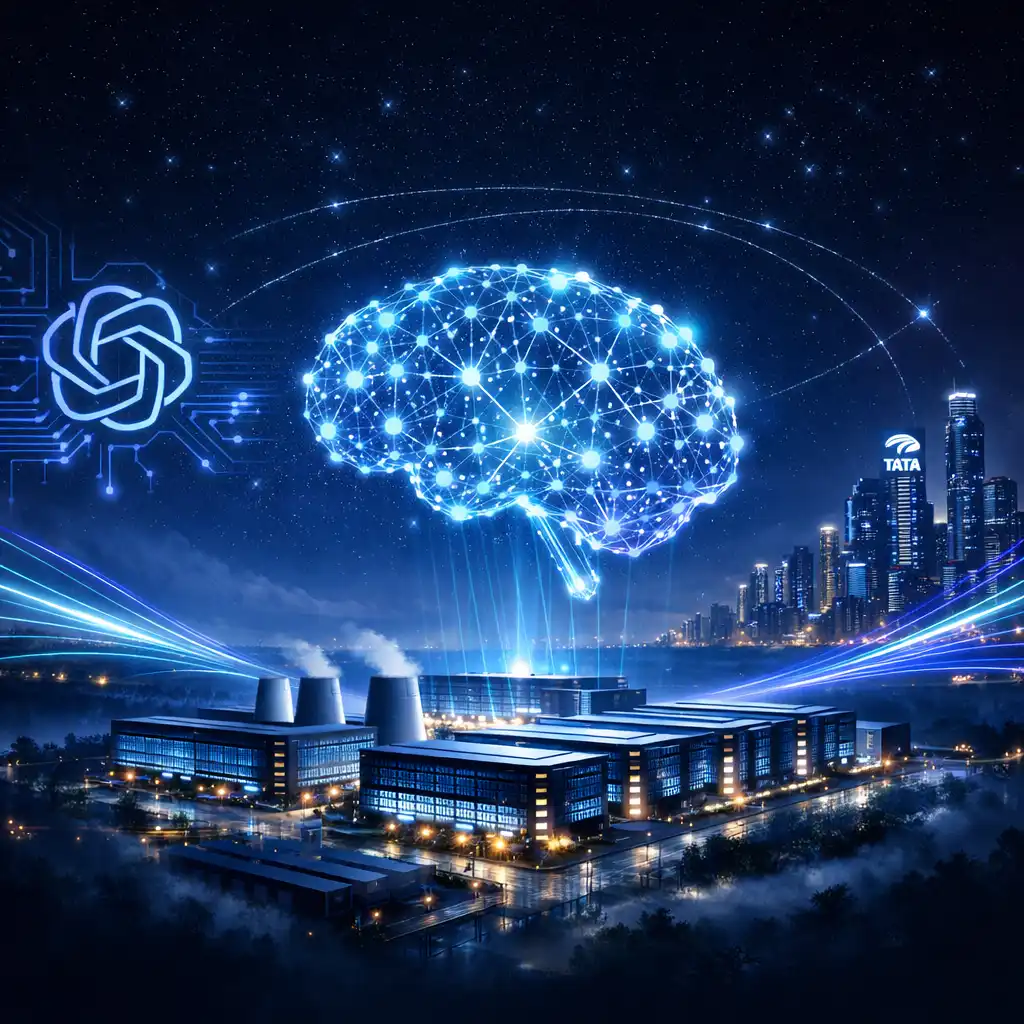
- OpenAI partnered with Tata Group for AI data center capacity in India.
- Initial deployment covers 100 megawatts of infrastructure.
- Long-term plans could scale to 1 gigawatt.
- The deal supports OpenAI’s global compute expansion strategy.
- Tata companies will also deploy enterprise AI tools internally.
Inside the OpenAI Tata Data Center Deal
The OpenAI Tata Data Center partnership marks a major step in global AI infrastructure expansion.
OpenAI secured 100 megawatts of data center capacity from Tata Group’s digital infrastructure business. The deployment will support AI model training, inference workloads, and enterprise services.
The agreement also includes a long-term pathway to scale capacity up to 1 gigawatt. That scale would place the project among the largest AI compute deployments globally.
This partnership positions India as a strategic geography in OpenAI’s infrastructure roadmap.
The Real Reason OpenAI Is Racing to Secure Compute Power
Modern AI systems require enormous computing power.
Training large language models consumes vast energy and hardware resources. The International Energy Agency notes that data centers already account for roughly 1 to 1.5 percent of global electricity demand.
As AI adoption accelerates, compute demand continues rising.
OpenAI has expanded infrastructure partnerships worldwide to meet this need. These partnerships help distribute workloads geographically while reducing latency for enterprise users.
The OpenAI Tata Data Center agreement reflects this scaling strategy.
How Much Power Is 100 Megawatts, Really?
A 100-megawatt deployment is not a small build.
This level of capacity can support tens of thousands of GPUs depending on configuration and power density.
AI training clusters often require specialized cooling, networking, and high-density rack design. Facilities must also handle sustained workloads without downtime.
According to the Uptime Institute, hyperscale AI facilities now push power densities beyond traditional cloud environments.
The OpenAI Tata Data Center infrastructure will support these high-performance requirements.
The Roadmap to 1GW Expansion
The long-term ambition extends far beyond the initial deployment.
Scaling to 1 gigawatt would multiply compute capacity tenfold. Few AI infrastructure projects globally operate at that scale today.
A gigawatt footprint would enable:
- Larger model training cycles
- Faster inference speeds
- Enterprise AI deployment at scale
- Regional cloud AI services
This expansion aligns with OpenAI’s broader infrastructure initiative to secure global compute supply.
Reuters reports that large-scale AI infrastructure programs are becoming central to national technology strategies.
Tata’s Growing Role in Global AI
Tata Group has steadily expanded its presence in digital infrastructure.
Its data center and cloud services divisions now serve hyperscale customers, government workloads, and enterprise clients.
The OpenAI Tata Data Center partnership strengthens Tata’s positioning in AI compute services.
India’s conglomerates are investing heavily in cloud, semiconductor ecosystems, and AI platforms.
The National Association of Software and Service Companies highlights AI infrastructure as a priority sector for India’s technology growth.
Enterprise AI Adoption Inside Tata Group
The partnership extends beyond infrastructure.
Tata companies plan to deploy OpenAI’s enterprise AI tools internally. This includes productivity, automation, and knowledge management applications.
Enterprise AI adoption often begins with:
- Workflow automation
- Customer service augmentation
- Internal copilots
- Document intelligence systems
Research shows generative AI could add trillions in productivity gains across industries.
The OpenAI Tata Data Center agreement supports both infrastructure supply and enterprise AI demand.
India’s Emergence as the Next AI Compute Powerhouse
India’s rise as an AI infrastructure destination is not accidental.
Several factors drive this shift:
1. Talent Density
India produces one of the world’s largest engineering workforces.
2. Cost Efficiency
Operational costs remain lower than Western markets.
3. Government Incentives
India’s digital infrastructure policies encourage data localization and cloud investment.
4. Market Demand
Domestic AI adoption is accelerating across finance, healthcare, and retail sectors.
The Ministry of Electronics and Information Technology has outlined national AI compute goals to support innovation.
The OpenAI Tata Data Center project aligns with these national ambitions.
Global Implications of the Partnership
This deal reflects a broader transformation in AI infrastructure geography.
Historically, AI compute clusters concentrated in the United States and parts of Europe. That concentration is now shifting.
New AI infrastructure hubs are emerging in:
- India
- Middle East
- Southeast Asia
Distributed infrastructure improves resilience and reduces geopolitical risk.
It also enables localized AI services compliant with regional data regulations.
Gartner forecasts global AI infrastructure spending will grow at double-digit rates through the decade.
The OpenAI Tata Data Center partnership represents this decentralization trend.
Why Infrastructure, Not Models, May Decide the AI Winners
Infrastructure access determines AI competitiveness. Companies with larger compute supply can train more advanced models faster. They can also deploy enterprise services more efficiently.
By partnering with Tata, OpenAI secures:
- Regional compute redundancy
- Scalable energy supply
- Enterprise customer proximity
- Long-term expansion capacity
These advantages strengthen its position in the global AI platform race.
Environmental and Energy Considerations
Large AI data centers raise sustainability questions because high-density compute facilities consume significant electricity and require intensive cooling systems. The International Energy Agency emphasizes that integrating renewable energy will be critical to support future data center growth responsibly.
Many hyperscale operators now pursue:
- Renewable energy sourcing
- Water-efficient cooling
- Heat reuse systems
- Carbon reporting frameworks
Infrastructure partnerships increasingly include sustainability targets.
Future expansion of the OpenAI Tata Data Center will likely follow these environmental benchmarks.
AI’s Shift From Software to Physical Power
The partnership signals three major shifts:
1. AI Compute Is Globalizing
Infrastructure is expanding beyond traditional tech hubs.
2. Enterprise Demand Is Surging
Corporate AI adoption drives compute needs.
3. Infrastructure Is Becoming Strategic
Nations view AI compute as critical digital infrastructure.
These forces will shape AI development through the next decade.
Conclusion
The OpenAI Tata Data Center partnership represents more than a capacity deal.
It reflects the accelerating race to secure AI compute worldwide.
The initial 100-megawatt deployment establishes India as a strategic infrastructure node. The potential expansion to 1 gigawatt signals long-term ambition at hyperscale levels.
For OpenAI, the agreement strengthens global training and deployment capabilities. For Tata, it reinforces its emergence as a serious player in AI infrastructure services.
Most importantly, the partnership illustrates how AI’s future will depend not only on algorithms, but on the physical systems powering them.
Discover how AI is reshaping technology, business, and healthcare—without the hype.
Visit InfluenceOfAI.com for easy-to-understand insights, expert analysis, and real-world applications of artificial intelligence. From the latest tools to emerging trends, we help you navigate the AI landscape with clarity and confidence.