Quick Summary
- The U.S. and China are in a high-stakes race for AI supremacy
- The U.S. leads in foundation models and chips
- China excels in data collection and AI adoption
- Military and geopolitical power are tied to AI innovation
- Global AI rules and influence are still up for grabs
Who’s Winning the Race for AI Supremacy in 2026?
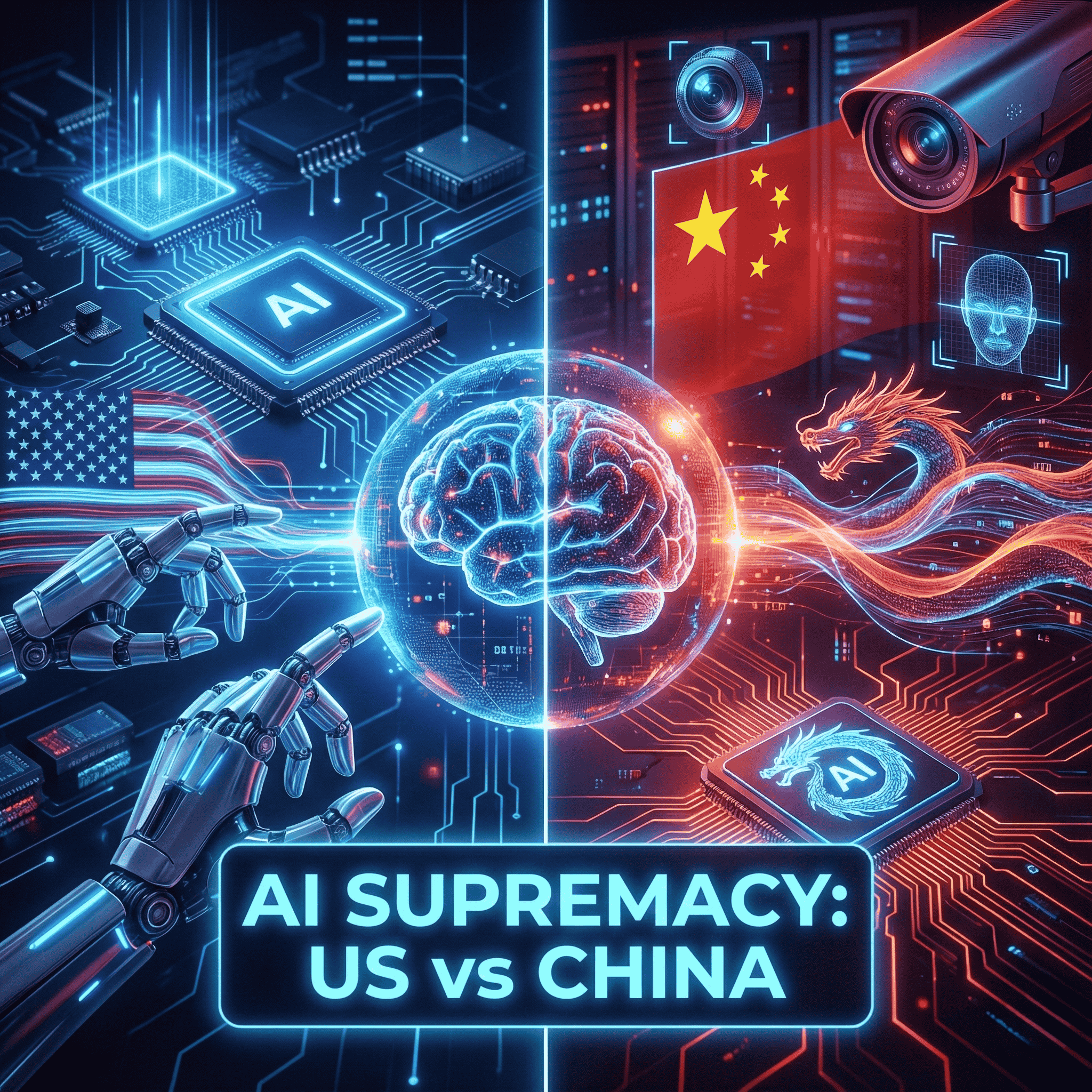
Artificial intelligence is now central to global power. From advanced language models to military applications, AI is shaping the future of innovation, national defense, and economic influence. At the center of this shift are two rivals. The United States and China. Each is moving fast to define what AI means for the world.
This isn’t just about building better tech. It’s about who gets to shape the rules.
What’s Really at Stake in the U.S.–China AI Race
AI supremacy is not only a tech milestone. It’s a strategic priority. For the U.S., leading in AI supports military strength, economic resilience, and global influence. For China, it’s a way to leapfrog traditional powers and set the pace for emerging technologies.
The U.S. National Security Commission on Artificial Intelligence stated that AI will “fundamentally alter” national security and warned that the U.S. must lead to avoid risks to democracy and freedom.
Key Events in the U.S.–China AI Race (2017–2025)
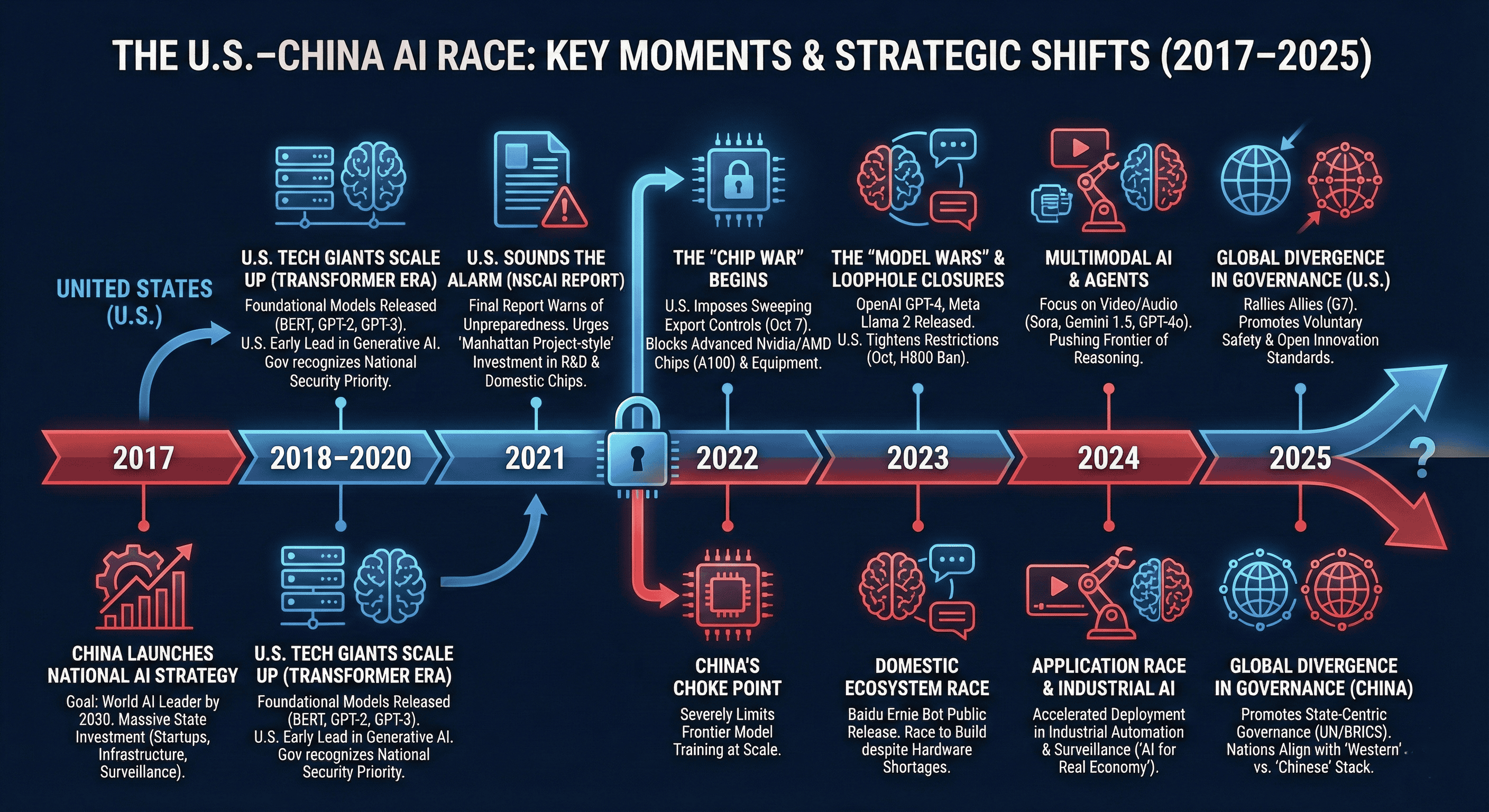
The U.S. Advantage in Foundation Models
The U.S. leads in large-scale AI research. Companies like OpenAI, Google DeepMind, Anthropic, and Meta are pushing boundaries with advanced foundation models. These models, trained on vast data, power everything from chatbots to productivity tools.
The U.S. also has a major edge in hardware. Nvidia’s GPUs, like the H100 and upcoming Blackwell chips, remain essential for training AI systems. Most top-tier AI labs rely on American-made processors.
Government investments are rising, too. The Biden administration has launched the U.S. AI Safety Institute to set guidelines and promote safe development.
China’s Strength in Scale and Data
China doesn’t lead in foundational models. But it excels in AI adoption. With over 1 billion citizens and a massive surveillance network, China gathers more real-world data than any other country.
This scale benefits companies like Baidu, Alibaba, and Tencent, which deploy AI across industries; from logistics to facial recognition. According to Stanford’s 2024 AI Index, China leads the world in published AI patents and AI-related scientific papers.
Government-led strategy plays a big role. China’s “New Generation AI Development Plan” includes ambitious national goals to become the global AI leader by 2030.
Military, Surveillance, and Strategy
AI’s role in defense and surveillance is growing. Both countries view AI as a military asset. The U.S. focuses on autonomous systems, predictive intelligence, and cybersecurity. China invests heavily in facial recognition, censorship tools, and battlefield AI.
According to the U.S. Department of Defense, AI is critical for maintaining an edge over strategic rivals. China’s military, known as the People’s Liberation Army, has incorporated AI into training simulations and command systems.
There’s concern that rapid deployment of untested AI in military settings could escalate conflicts.
AI and Global Influence
This race isn’t just between governments. It’s also about shaping global norms.
The U.S. supports open development and partnerships. Through the G7’s Hiroshima Process, America has pushed for voluntary AI safeguards. In contrast, China promotes stricter government control and AI regulation aligned with party interests.
Countries across Asia, Africa, and Latin America may have to choose which model to follow. That choice could influence digital rights, surveillance policies, and trade agreements.
The Risks of a Divided AI Future
The divide between the U.S. and China could lead to a fragmented tech landscape. If each country builds its own AI ecosystems, it could split the internet. Apps, protocols, and standards might not work across borders.
This concept, often called a “bifurcated internet,” has already begun. For example, TikTok’s Chinese version, Douyin, operates under stricter rules than the global app.
A split ecosystem could limit innovation and deepen mistrust.
What Comes Next
The race for AI supremacy is still unfolding. The U.S. leads in raw research and infrastructure. China leads in real-world application and scale. Both are investing billions.
This rivalry will shape not just the future of AI, but the future of power. As AI tools grow more influential, so does the responsibility to build them wisely.
The outcome isn’t just about which country “wins.” It’s about what kind of world AI creates.
Discover how AI is reshaping technology, business, and healthcare—without the hype.
Visit InfluenceOfAI.com for easy-to-understand insights, expert analysis, and real-world applications of artificial intelligence. From the latest tools to emerging trends, we help you navigate the AI landscape with clarity and confidence.