Quick Summary
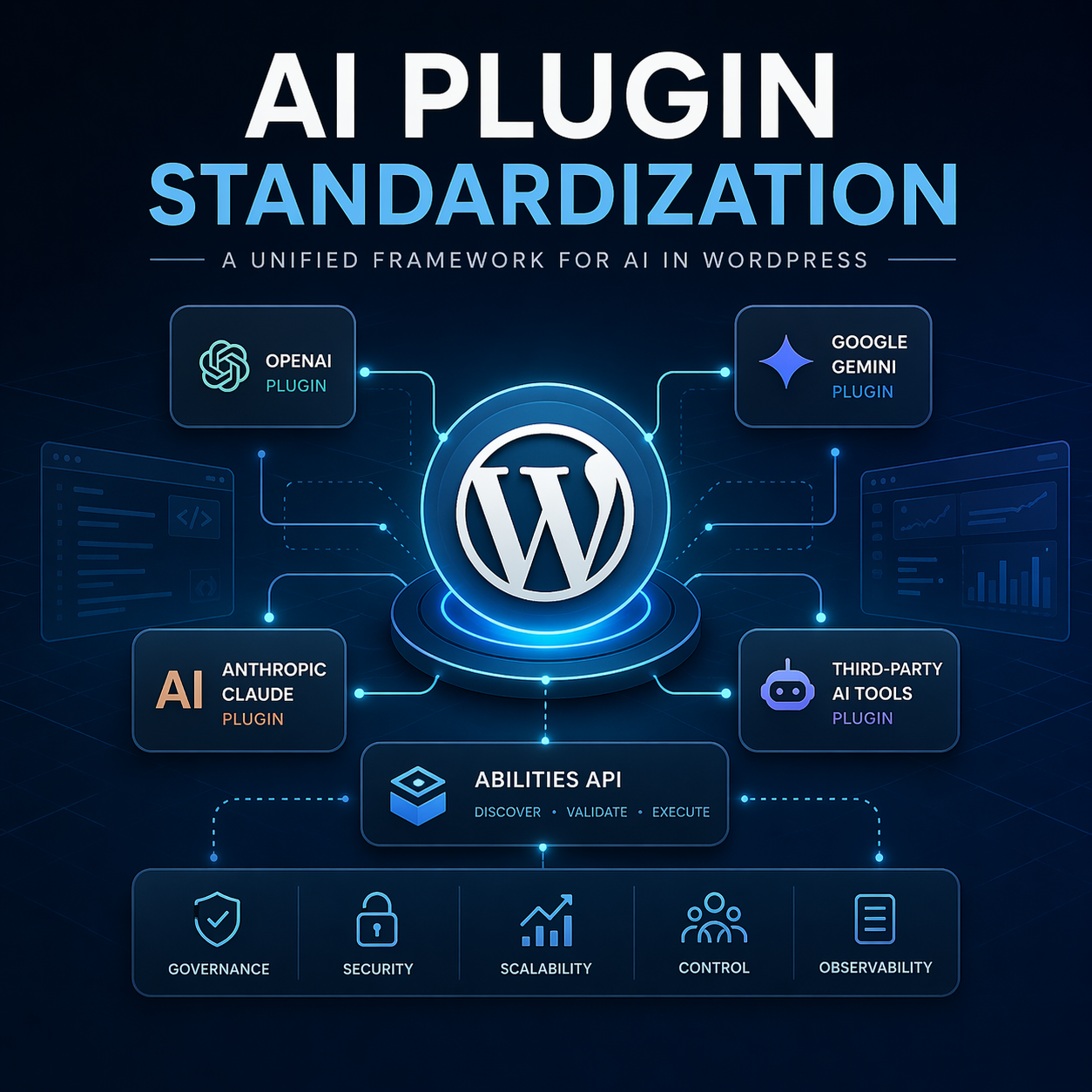
- WordPress introduces a standard system for AI plugins
- The Abilities API defines how AI tools are registered and used
- Official provider plugins connect models like OpenAI and Gemini
- Enterprises gain more control over AI workflows
- Fragmentation across plugins is reduced
- The system supports scaling AI across large sites
What happened with WordPress AI plugin standardization
WordPress AI plugin standardization introduces a new way to manage AI tools inside the platform. The update centers on a shared framework that allows plugins to work together more consistently. This reduces the need for separate integrations across tools.
The change reflects a push to organize how AI features are built and deployed. Instead of each plugin handling AI differently, WordPress now provides a common structure. This helps unify how capabilities are exposed to developers and users.
At the center of this shift is a system that allows AI features to be registered and discovered. This makes it easier to coordinate tools across a site or organization.
Technical details behind the Abilities API
The core of WordPress AI plugin standardization is the Abilities API. This system defines how AI capabilities are described, registered, and executed. It creates a shared layer between plugins and AI providers.
Developers can define abilities as structured functions. These abilities can then be accessed across plugins without custom integration. This removes the need to rebuild similar connections for each tool.
The system also introduces official provider plugins. These plugins connect WordPress to external AI services such as OpenAI, Google Gemini, and Anthropic Claude. Each provider follows the same structure within the framework.
A registry keeps track of available abilities. This allows plugins to discover and use them in a consistent way. It also supports validation to ensure compatibility across the system.
Execution flows through a defined interface. This makes behavior more predictable. It also improves how developers test and deploy AI features.
Context and significance
WordPress AI plugin standardization addresses a common issue in AI adoption. Many tools operate in isolation. This creates complexity when teams try to scale across systems.
A shared framework reduces that friction. It allows different plugins to work together using the same structure. This improves efficiency and reduces maintenance work.
Enterprises benefit from better control over how AI tools are used. The system supports governance through standardized inputs and outputs. This helps teams monitor behavior and enforce internal rules.
Research shows that consistent system design improves interoperability. This aligns with the need for reliable enterprise AI environments.
The update also supports scalability. Teams can deploy AI features across multiple sites without rebuilding integrations. This makes expansion more practical.
What to watch
Adoption will depend on how widely the framework is used. Developers and agencies need to build around the Abilities API for the system to succeed. Early adoption will shape how useful the standard becomes.
The strength of provider plugins will also matter. These plugins act as the connection between WordPress and AI services. Their quality will affect performance and reliability.
Enterprises will look for strong governance features. Logging, monitoring, and access control will play a key role. These elements determine whether the system can meet enterprise standards.
Guidance from European Union Agency for Cybersecurity highlights the importance of structured systems in managing risk. This applies directly to AI integration.
The next phase will depend on how well the framework handles real-world use. Adoption across large organizations will test its limits.
Conclusion
WordPress AI plugin standardization introduces a structured approach to AI integration. It replaces fragmented systems with a shared framework built around the Abilities API. This allows plugins and providers to operate within a consistent model.
For enterprises, this reduces complexity and improves control. Teams can manage AI tools more effectively across sites and workflows. Developers benefit from a clearer and more predictable system.
The long-term impact depends on adoption and execution. If widely supported, this framework could become a foundation for scalable AI inside WordPress.
Discover how AI is reshaping technology, business, and healthcare—without the hype.
Visit InfluenceOfAI.com for easy-to-understand insights, expert analysis, and real-world applications of artificial intelligence. From the latest tools to emerging trends, we help you navigate the AI landscape with clarity and confidence.