Quick Summary
- The China vs US AI race is divided across different strengths
- The US leads in AI “brains” like LLMs and advanced chips
- China leads in AI “bodies” such as robotics and drones
- Export controls have helped the US maintain chip dominance
- China’s DeepSeek showed it can compete with fewer resources
- Robotics scale and manufacturing give China a major edge
- Experts say the outcome depends on long-term adoption and impact
A new kind of global race
The China vs US AI race has become one of the defining competitions of this century. It has replaced earlier geopolitical rivalries with a focus on technology, especially artificial intelligence.
This contest is unfolding across research labs, universities, and major technology companies. Governments are also deeply involved, with large investments and national strategies guiding progress.
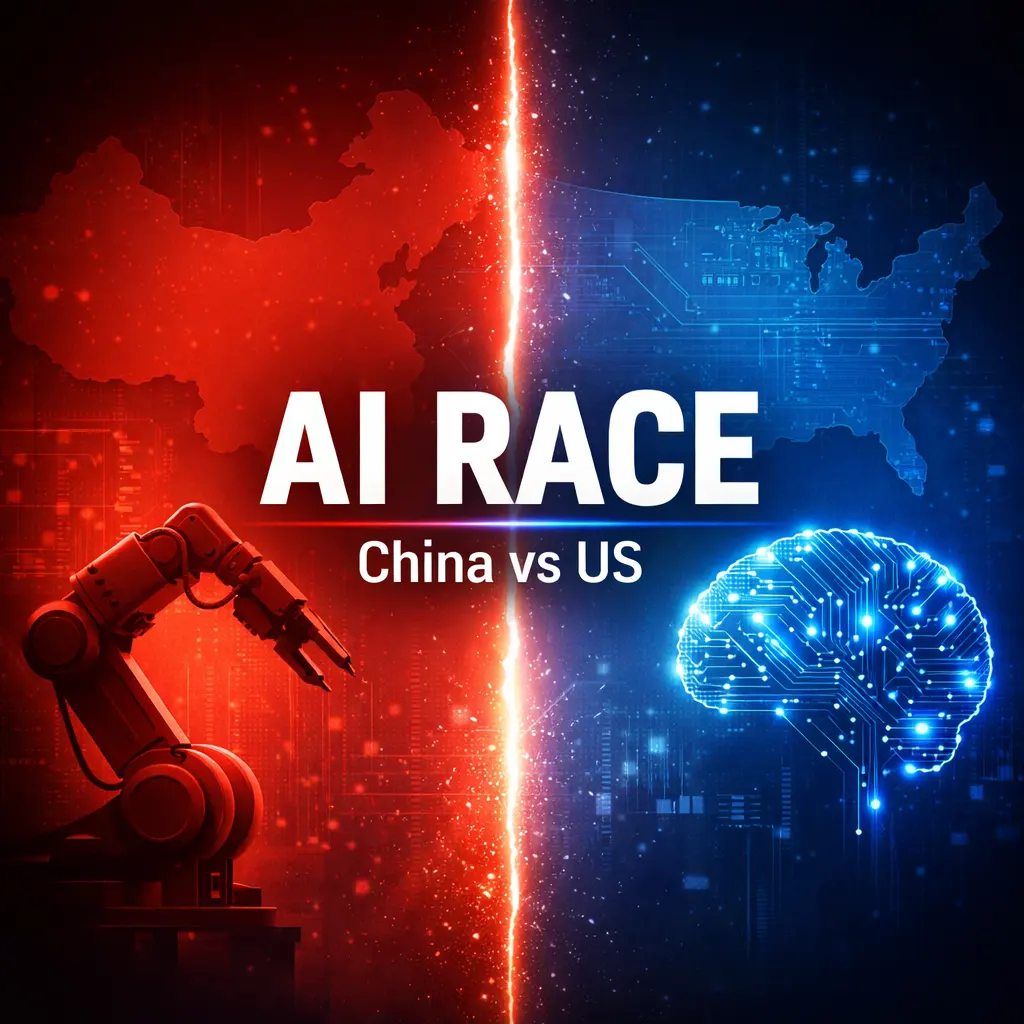
Experts describe the competition as a battle between “brains” and “bodies.” The US has traditionally led in AI brains, while China has focused on AI bodies.
This balance may not hold. Both countries are pushing to close gaps and expand their strengths.
The US lead in AI brains
The US has a clear advantage in AI systems that power reasoning, language, and decision-making. These systems are often referred to as AI brains.
The launch of OpenAI’s ChatGPT in 2022 marked a major turning point. It brought large language models into mainstream use and showed their commercial potential.
Millions of people began using these systems in daily life. Companies across the US quickly invested billions to build competing models.
American firms continue to lead in this area. Their models are widely seen as more advanced, though the gap is narrowing.
This leadership also connects to white-collar automation. These systems can perform tasks that were once done by humans, which increases their economic value.
Chips and control shape the battlefield
The US advantage in AI brains is closely tied to control over advanced microchips. These chips provide the computing power needed to train large AI models.
A large share of high-end chips are designed by Nvidia. The company has become one of the most valuable in the world due to demand for AI hardware.
The US government has also imposed export controls to limit China’s access to these chips. These policies have been strengthened in recent years.
Even chips produced outside the US are affected. Rules require companies to follow US restrictions if their products rely on American technology.
Another key bottleneck is manufacturing equipment. A Dutch company produces the machines needed to create advanced chips, and exports to China are restricted.
These measures have helped the US maintain its lead in AI infrastructure.
China’s DeepSeek moment
China has responded by developing its own AI systems despite these restrictions. A key moment came with the release of DeepSeek in 2025.
DeepSeek offers capabilities similar to leading US models. It can answer questions, write code, and perform complex tasks.
What made it notable was cost. It was developed using far fewer computing resources than comparable US systems.
This raised concerns in Washington. It suggested that export controls may have pushed Chinese developers to become more efficient.
DeepSeek also reflects a different approach. Chinese companies often share their models openly, which allows others to build on existing work.
This approach speeds up development and lowers barriers for innovation.
China’s strength in robots and real-world systems
While the US leads in AI brains, China has built a strong lead in AI bodies. This includes robotics, drones, and automated systems.
The Chinese government has invested heavily in this area. It has funded research and supported companies with large subsidies.
China now has around two million working robots. That figure exceeds the rest of the world combined.
These systems are deeply integrated into everyday life. Cities like Shenzhen and Shanghai use robots for delivery and services.
China also dominates humanoid robot production. It accounts for about 90% of global exports in this category.
Manufacturing plays a key role. China’s expertise in building electronics has helped it scale robotics quickly.
Advanced robots still depend on AI software
Despite China’s strength in robotics, each machine still needs intelligent software. This is where AI brains become essential again.
Simple robots can perform repetitive tasks with basic programming. More advanced robots require systems that can plan and adapt.
This type of AI is often called agentic AI. It allows machines to act independently and complete complex tasks.
Experts say the US still leads in this area. The software and chips that power these systems are critical to overall performance.
In fact, a large share of a robot’s value comes from its brain rather than its physical structure.
This creates a dependency between hardware and software leadership.
A race with no clear finish line
The China vs US AI race does not have a clear endpoint. Experts say it is not like a single event with a defined winner.
What matters is long-term advantage. This includes who builds better systems, who deploys them widely, and who shapes global standards.
Different strategies are emerging. US companies tend to move quickly with fewer restrictions. China places more emphasis on state oversight.
The outcome may depend on adoption rather than invention. The country that integrates AI more deeply into its economy could gain the edge.
Both nations are playing different games. Each is strong in its own domain.
Conclusion
The China vs US AI race is defined by contrasting strengths. The US leads in AI brains, while China dominates in AI bodies.
Recent developments show that these lines are starting to blur. China is catching up in advanced models, while the US is advancing in robotics.
The race remains open. Future breakthroughs, policy decisions, and real-world adoption will shape the outcome.
What is clear is that this competition will play a major role in defining global power in the years ahead.
Discover how AI is reshaping technology, business, and healthcare—without the hype.
Visit InfluenceOfAI.com for easy-to-understand insights, expert analysis, and real-world applications of artificial intelligence. From the latest tools to emerging trends, we help you navigate the AI landscape with clarity and confidence.